Vortioxetine and Erectile Dysfunction: Does This Antidepressant Affect Libido?
Written by Dr. Pranitha Bangera

Dr. Pranitha Bangera is a gold-medalist healthcare professional with an elite foundation in clinical training and patient care. A researcher at heart, she specializes in creating high-impact, research-driven medical content that empowers readers through accessible patient education. Dr. Bangera focuses on the intersection of digital health and clinical communication, specifically within the fields of sexual health and mental well-being. Her work is dedicated to making complex medical innovations understandable and trustworthy for a global audience.
•
July 30, 2026
Our experts continually monitor the health and wellness space, and we update our articles when new information becomes available.
Quick Read
If you’re searching for whether vortioxetine affects libido or erections, the short answer is: it can, but usually far less than older antidepressants. Sexual side effects mostly appear at higher doses and are usually temporary, dose-dependent, and reversible. Vortioxetine can even improve ED in people who developed sexual problems on SSRIs because of its gentler, multi-pathway action in the brain. In this article, you learned how vortioxetine may cause or help ED, whether these effects last, how it compares with other antidepressants, and practical steps to manage or prevent symptoms. With the right dose and support, most people are able to balance good mental health with healthy sexual function.
Can vortioxetine cause erectile dysfunction? Yes, but the risk is generally much lower than with SSRIs and SNRIs. While some people taking vortioxetine (Trintellix) may experience erectile dysfunction, reduced libido, or delayed orgasm, these sexual side effects are usually mild, dose-dependent, and often improve after lowering the dose or continuing treatment.
Unlike many older antidepressants, vortioxetine has a multimodal mechanism of action that appears to preserve sexual function in many patients. In fact, some people who developed sexual side effects on SSRIs notice improvements after switching to vortioxetine. However, sexual dysfunction can still occur, particularly at higher doses or in people whose depression itself affects sexual function.
This article explains how vortioxetine affects erections and libido, why sexual side effects occur, how its ED risk compares with other antidepressants, and what treatment options are available if symptoms develop.

Allo asks
What’s your main concern on vortioxetine?
Does Vortioxetine Cause Erectile Dysfunction?
Yes, vortioxetine can cause erectile dysfunction (ED), but the risk is generally much lower compared to other antidepressants like SSRIs and SNRIs. [?] The frequency of erectile dysfunction with vortioxetine varies depending on the assessment method used:
- When doctors use a structured questionnaire like the Arizona Sexual Experience Scale (ASEX), sexual dysfunction with vortioxetine shows up in 16–34% of patients taking 5–20 mg/day. [1]
- But when patients are not asked directly and only report problems on their own, sexual side effects appear much lower, around 2–5% in men. [1]
- In studies comparing medications, vortioxetine performed much better than traditional SSRIs (serotonergic antidepressants). [2]
- When compared to paroxetine (an SSRI well-known for sexual side effects), vortioxetine 10 mg caused far fewer sexual problems. [3]
How Does Vortioxetine Cause Erectile Dysfunction?
1. Brainchemical Imbalance
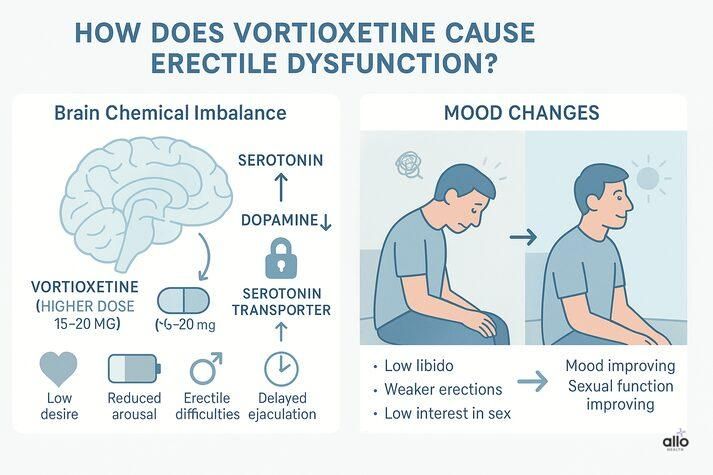
When serotonin levels rise too high in certain brain areas, it can affect dopamine, the brain chemical responsible for sexual desire, arousal, and performance — a pathway also disrupted by Amitriptyline and sex drive. That’s why many antidepressants that boost serotonin can cause things like delayed ejaculation or reduced sexual desire. At higher doses (like 15–20 mg), vortioxetine blocks more serotonin transporters. This means the medicine holds onto more serotonin in the brain, which increases serotonin levels, and that can affect sexual desire or performance. [4] This can increase the chance of:

- Erectile difficulties
- Reduced arousal
2. Mood Changes
Sometimes the issue isn’t the medicine at all, it’s the condition being treated. When someone is struggling with depression, it can naturally reduce libido, weaken erections, and lower overall interest in sex. As treatment starts working and mood improves, sexual function often begins to improve as well. [1]
Can Vortioxetine Help With Erectile Dysfunction?
Even though vortioxetine can sometimes cause sexual side effects, it also has a unique advantage — a lower overall sexual burden than most antidepressants and ED. For many people, it can actually improve erectile function, especially if another antidepressant caused their ED. Here's how:
1. Works on Several Serotonin Switches
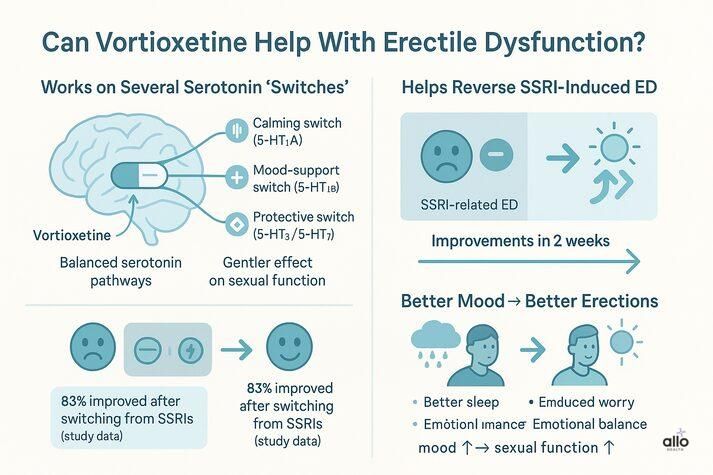
Vortioxetine is different from classic SSRIs because it has multimodal activity. This means that the medicine works in several different ways at the same time, instead of just one. It affects different “switches” ( 5-HT receptor subtypes) in the brain:
- One switch calms you
- One helps with mood
- Others may actually protect sexual function
Because it hits many switches instead of just one to treat the condition, vortioxetine usually causes milder sexual side effects than older SSRIs. [1]
2. Can Reverse Antidepressant-Induced ED
In a major study where patients switched from SSRIs because of sexual dysfunction, vortioxetine showed greater improvement in sexual desire and overall satisfaction than escitalopram. Over 83% had improvement, and the benefits often appeared within 2 weeks of switching. Improvements were seen in erection quality and sexual desire. This makes vortioxetine a strong “rescue option” for SSRI-related ED. [5]

3. Better Mood
Many men experience ED because of stress, worry, or emotional exhaustion. When vortioxetine improves mood, energy, and clarity without heavily suppressing sexual function, erections often improve naturally over time.
Is ED Caused by Vortioxetine Permanent?
No, ED caused by vortioxetine is not permanent. It’s usually dose-related, improves quickly once the dose is lowered, and often resolves within a few weeks if the medication is adjusted or switched. Long-lasting issues like PSSD (Post-SSRI Sexual Dysfunction) are mostly linked to older SSRIs, not vortioxetine.
ED Risk: Vortioxetine vs. Other Antidepressants
The table below gives you a quick, easy comparison of ED risk across commonly used antidepressants:
Medication
ED Risk
Bupropion
Least risk (sometimes added to fix sexual side effects)
Vortioxetine 5 mg
Low risk
Vortioxetine 10 mg
Low risk
Vortioxetine 20 mg
Dose-dependent sexual dysfunction is the general rule — and augmentation strategies like Buspirone and ED are sometimes used to mitigate it.
Duloxetine (SNRI)
Moderate risk
Escitalopram (SSRI)
High risk
Sertraline (SSRI)
High risk
Paroxetine (SSRI)
Highest risk
How to Manage ED Caused by Vortioxetine
1. Adjust the Dose
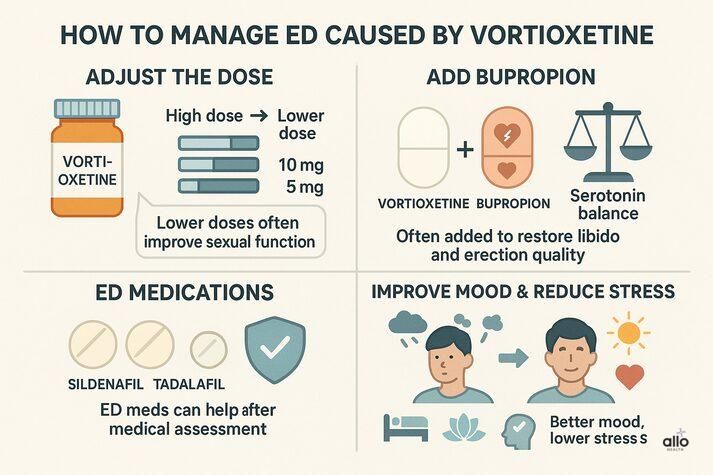
Lowering the dose from 20 mg → 10 mg or 10 mg → 5 mg often improves sexual function without losing antidepressant efficacy.
2. Consider Adding Bupropion
A common strategy used by psychiatrists to restore libido and erection quality is to add bupropion alongside vortioxetine, since bupropion has a very low risk of sexual side effects and can help balance the serotonin-related issues.
3. Consider ED Medications
Medications like sildenafil (Viagra) and tadalafil (Cialis) can be used safely in many patients after medical assessment.
4. Address Depression & Anxiety
Sexual function improves naturally as:
- Mood improves
- Stress decreases
- Sleep stabilizes
Many people think they have to choose between feeling emotionally better and keeping their sexual health intact, but that’s not true. Medications like vortioxetine give us more balanced options.
How to Prevent ED Caused by Vortioxetine
1. Start Low
Beginning at 5 mg minimizes risk, especially for those who previously had issues with SSRIs.
2. Maintain Good Overall Health
Healthy blood flow is essential for erections. Simple habits can improve blood vessels, blood pressure, and erection quality:
- Exercise
- Better sleep
- Stress management
- Limiting alcohol
- Avoiding nicotine
- Balanced diet
3. Support Your Mental Health
Supporting your mental health plays a big role in preventing ED while taking vortioxetine — and partners dealing with their own desire changes may want to read up on female erectile dysfunction. When stress, worry, or emotional overload eases, the body’s natural sexual response becomes stronger and more consistent. Psychotherapy for ED, mindfulness practices to reduce stress, better sleep routines, or talking openly with a partner can reduce performance pressure and improve confidence. As your mind feels calmer and more balanced, it becomes easier for your body to respond the way you want it to.
Conclusion
Vortioxetine is considered one of the most sexually friendly modern antidepressants, especially for people who have struggled with sexual dysfunction on SSRIs. While vortioxetine sexual side effects, including ED, low libido, and delayed orgasm, can still occur, they are usually milder, dose-dependent, and reversible. Most people notice improvements within weeks after adjusting the dose or switching medications. And for many patients, fixing depression itself leads to better sexual response, stronger erections, and healthier desire. If sexual side effects are affecting your confidence or relationship, don’t hesitate to talk to a sexual health expert. With the right plan, you can feel like yourself again while still getting the emotional support you need from your antidepressant.
Disclaimer
The following blog article provides general information and insights on various topics. However, it is important to note that the information presented is not intended as professional advice in any specific field or area. The content of this blog is for general educational and informational purposes only. The content should not be interpreted as endorsement, recommendation, or guarantee of any product, service, or information mentioned. Readers are solely responsible for the decisions and actions they take based on the information provided in this blog. It is essential to exercise individual judgment, critical thinking, and personal responsibility when applying or implementing any information or suggestions discussed in the blog.
Most Asked Questions
. Why does vortioxetine affect sexual desire or erections?
Higher serotonin levels can sometimes slow sexual response. This may affect libido, erections, or orgasm — especially at higher doses.
Can vortioxetine actually improve sexual function?
Yes. For many people who developed ED on SSRIs, switching to vortioxetine improves desire, arousal, and erection quality — often within 2–4 weeks.
Should I stop vortioxetine if I get ED?
No, don’t stop suddenly. Instead, speak to your doctor — they may lower the dose, add bupropion, or suggest a different medication if needed.
How long do vortioxetine sexual side effects last?
If they appear, they often improve in a few weeks — especially after adjusting the dose. Persistent issues are uncommon.
Can ED meds like Viagra or Cialis be used with vortioxetine?
Yes, many people safely use them together after medical assessment. Always check with a doctor before starting ED medication.
Sources
- 1.
Treatment-emergent sexual dysfunction in randomized trials of vortioxetine for major depressive disorder or generalized anxiety disorder: a pooled analysis
- 2.
Can Vortioxetine Ameliorate SSRI-Induced Sexual Dysfunction in Well-Treated MDD?
- 3.
Paroxetine, but not Vortioxetine, Impairs Sexual Functioning Compared With Placebo in Healthy Adults: A Randomized, Controlled Trial
- 4.
Antidepressants and Sexual Dysfunction: Is Vortioxetine Among the Exceptions?
- 5.
Switching to Vortioxetine in Patients with Poorly Tolerated Antidepressant-Related Sexual Dysfunction in Clinical Practice: A 3-Month Prospective Real-Life Study