Botox Injections for Erectile Dysfunction: Experimental Treatment
Written by Dr. Deepali Anand

Dr. Deepali is a medical writer and healthcare professional with a background in clinical surgery and patient care. Having transitioned from active clinical practice to medical communications, she specializes in bridging the gap between complex clinical data and patient education. Dr. Deepali is dedicated to creating evidence-based content that is grounded in scientific rigor and empathy, ensuring that sensitive topics like sexual wellness and mental health are accessible and empowering for every reader.
•
July 30, 2026
Our experts continually monitor the health and wellness space, and we update our articles when new information becomes available.

Quick Read
Botox for erectile dysfunction is an experimental treatment that shows promise but is not yet FDA-approved. It works by relaxing smooth muscles in the penis to improve blood flow, similar to how Viagra works. Early studies suggest it may help 40-77% of men who don't respond to standard ED medications, with effects lasting about three months. While side effects appear mild, it's still in the testing phase and requires more research. For now, talk to your doctor about proven treatments, Botox for ED remains an investigational option, not a go-to solution.
Botox for erectile dysfunction is one of the newest and most talked-about experimental approaches for men struggling with erection problems. While Botox is widely known for smoothing wrinkles, researchers are now exploring whether it could also help improve blood flow to the penis and enhance erectile function.
Early studies show promising results, especially for men who don’t respond well to common ED medications like Viagra or Cialis, but it’s still too soon to call it a proven treatment.
In this article, you’ll learn how Botox might work for ED, what research says so far, who may benefit, and the potential risks and limitations you should know before considering it.

Allo asks
Have you ever heard about Botox being studied as a treatment for erectile dysfunction?
What is Botox, and Does it Work for ED?
Botox, short for Botulinum Toxin A, is commonly used in cosmetic treatments to reduce wrinkles. It works by temporarily relaxing or paralyzing smooth muscle, wherever it’s injected.

In recent years, researchers have begun exploring Botox as an off-label treatment for erectile dysfunction — much like how drugs used for other indications, such as antibiotics and ED, have been re-examined.
Some early research studies and clinical trials have shown promising results, suggesting that Botox might help improve blood flow and erection strength.[1] But it’s important to remember that Botox is not yet approved by the FDA for treating ED, and larger studies are still needed to fully understand how safe and effective it really is.
According to Allo Health, every 1 in 2 patients has ED, which is based on our internal clinical data of more than 2.5 Lakh patients who come to us for consultations. Iatrogenic factors like antihistamines and ED are also common culprits.

How Botox for Erectile Dysfunction Might Work
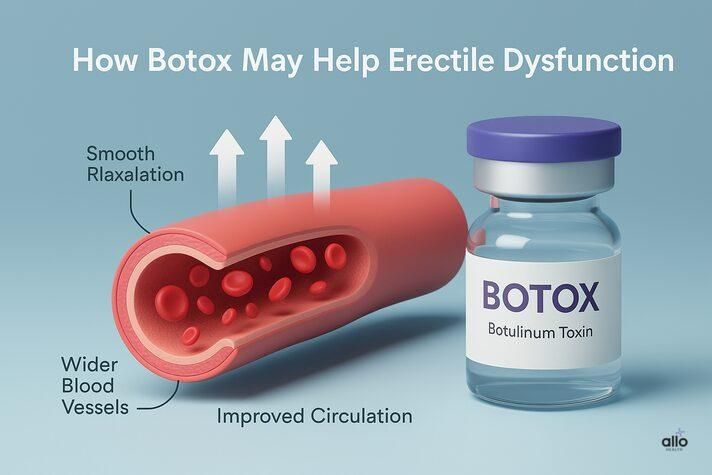
The main idea behind studying Botox for erectile dysfunction lies in how it relaxes smooth muscles. When Botox is injected into the penis (into the intracavernosal smooth muscles), it helps block certain nerve signals that normally cause these muscles to tighten.
By relaxing these muscles, Botox promotes vasodilation, meaning it widens blood vessels and allows better blood flow to the penis, which is a key part of achieving and maintaining an erection.[2]
In this way, its action is somewhat similar to PDE5 inhibitors (like Viagra or Cialis), and it may work for men who don’t respond well to standard ED medications.
It’s important to note that this understanding is still based on theoretical and early clinical research. Larger, long-term studies are ongoing to confirm the overall safety and effectiveness of Botox for erectile dysfunction.
Botox injections for erectile dysfunction are still in the early stages of research. Some studies show improved blood flow and erection quality, but it’s too soon to call it a proven treatment. For now, it’s best viewed as an experimental option that may hold promise for the future

What Does the Research Say About Botox for Erectile Dysfunction?
Several early studies and reviews have looked at the use of Botox for erectile dysfunction, and the results so far are hopeful, though still at a testing stage.
In one study, about 4 out of 10 men who received Botox were able to get erections firm enough for sex, compared to men who got a dummy (placebo) shot.[3] Most of these men had not responded well to regular ED medicines like Viagra, Cialis, or injection-based ED treatments.
A larger review that combined results from many studies found that around 77% of men showed improvement after getting Botox injections for ED — promising numbers, though smaller than what’s been debated with aspirin and ED.
Overall, these studies suggest that Botox could become a new option for men who don’t get results from standard ED treatments. But it’s still experimental, and scientists need to do larger, long-term studies to make sure it’s safe and effective for regular use.
Potential Risks and Side Effects of Botox for Erectile Dysfunction
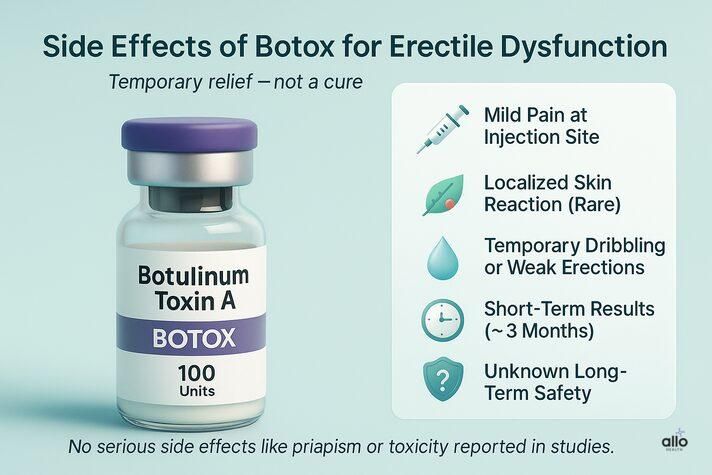
The effects of Botox for erectile dysfunction are temporary; it may improve erections for a short period, but it’s not a permanent cure.
So far, research suggests that Botox injections for ED are generally safe and well-tolerated, with only a few mild side effects reported.[5]Commonly observed effects include:
- Mild pain or soreness at the injection site
- Occasional local skin reaction (such as slight redness or irritation)
- Temporary dribbling or weaker erections, which usually go away on their own
- Short-lived results, typically lasting about three months
- Unknown long-term safety, as larger studies are still needed
Importantly, no serious side effects such as priapism (a prolonged erection) or overall toxicity were reported in studies.
Who Might Benefit from Botox for ED?
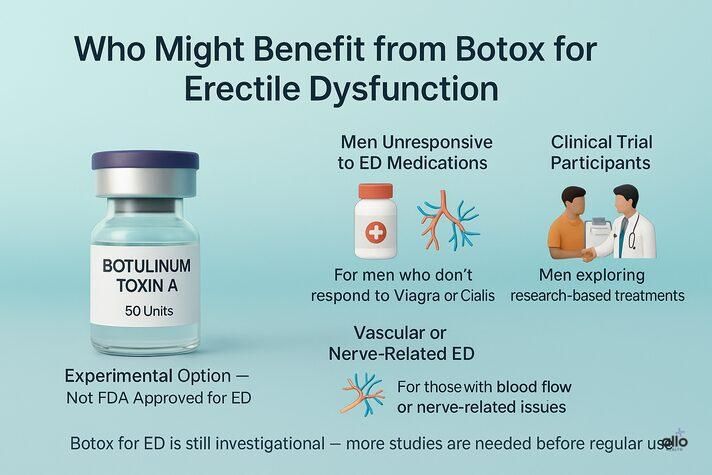
While Botox is approved by the FDA for several medical conditions, it is not yet approved for treating erectile dysfunction. For now, its use in ED is considered experimental or investigational.
Botox may be explored as a second-line option for:
- Men with difficult-to-treat ED who don’t respond to oral medications (like Viagra or Cialis) or standard injection therapy.
- Individuals with vascular ED or nerve-related causes of ED, where blood flow or nerve function is affected.
- Patients participating in clinical trials looking for new, science-backed treatment alternatives.
That said, Botox should not be used as a first-line therapy. More research is still needed to confirm its safety, dosage, and long-term effectiveness before it becomes a regular part of ED treatment.
Bottom Line
Botox for erectile dysfunction shows genuine promise, but it’s still in the experimental stage and not yet approved by the FDA — complementary nutrients like Propionyl-L-Carnitine for ED are another emerging angle.
If you’re dealing with erection problems, it’s best to speak openly with your doctor. They can help identify the underlying cause and guide you toward proven treatments, such as prescription medications, therapy, or healthy lifestyle changes, that are both safe and effective for now.

Disclaimer
The following blog article provides information about a drug or brand name drug and its potential effects or benefits. However, it is crucial to understand that this information is intended for general educational purposes only and should not be considered a substitute for professional medical consultation. It is highly recommended to consult with a qualified healthcare professional before making any decisions regarding medication, treatment, or healthcare management. Individuals have unique medical conditions, and the information provided in this article may not be applicable to everyone. Only a qualified healthcare provider can evaluate your specific medical situation, taking into account your medical history, conducting appropriate tests, and providing personalized advice and recommendations. They are equipped to make informed decisions tailored to your individual needs. It is crucial to emphasize that self-diagnosis, self-medication, or disregarding medical advice can have serious health consequences. This article may reference specific brand names or drugs for illustrative purposes. Mention of these names does not imply endorsement, recommendation, or guarantee of their efficacy or safety. The choice of medication should be based on discussions and individualized guidance from a healthcare professional who has a comprehensive understanding of your medical condition.
Most Asked Questions
Is Botox safe for erectile dysfunction?
So far, studies show Botox for erectile dysfunction is generally safe, with mild side effects like temporary soreness or slight irritation. However, long-term safety data is limited, and the treatment isn’t FDA-approved for ED yet.
What is the fastest way to cure erectile dysfunction?
There’s no instant cure, but the fastest and safest improvement usually comes from doctor-guided treatments — such as oral ED medications, lifestyle changes, and therapy for stress or anxiety. Experimental treatments like Botox for ED may help in the future but aren’t yet approved.
Which injection is best for erectile dysfunction?
Currently, FDA-approved options such as alprostadil injections (Caverject, Edex) are the safest and most effective. Botox injections for ED are still considered experimental and should only be done as part of a clinical study or under medical supervision.
Where is Botox injected for erectile dysfunction?
For ED treatment, Botox is injected into the smooth muscle of the penis (called the intracavernosal area). These injections must be performed only by a qualified urologist or trained specialist in a clinical setting.
How long does Botox for ED last?
Botox for erectile dysfunction usually provides results that last about three months. Since its effects are temporary, repeat treatments may be needed if the results wear off. Researchers are still studying the ideal duration and frequency for long-term safety.
Sources
- 1.
The effectiveness and safety of intracavernosal botulinum toxin injections in the management of erectile dysfunction: a systematic review and meta-analysis of clinical studies
- 2.
Safety and Effectiveness of Repeated Botulinum Toxin A Intracavernosal Injections in Men with Erectile Dysfunction Unresponsive to Approved Pharmacological Treatments: Real-World Observational Data
- 3.
Intra-cavernous injection of BOTOX® (50 and 100 Units) for treatment of vasculogenic erectile dysfunction: Randomized controlled trial
- 4.
Efficacy and safety of botulinum toxin-A injection in the treatment of premature ejaculation: A systematic review and meta-analysis
- 5.
BOTULINUM TOXIN