With a strong academic background in dentistry and clinical exposure, Dr. Sharon who has studied at PDM Dental College, brings a valuable blend of medical knowledge and communication skills to health content writing. She is passionate about creating clear, compassionate, and evidence-based content on topics such as general wellness, sexual health, oral care, and patient education. Her goal is to make complex medical information easy to understand, relatable, and genuinely helpful for readers seeking clarity on their health concerns. Dr. Sharon believes in the power of well-researched, empathetic content to educate and empower people to make better health decisions. Whether it’s writing about preventive care or breaking down myths in sexual wellness, her content always balances science with sensitivity.
Our experts continually monitor the health and wellness space, and we update our articles when new information became available.
Updated on 12th November 2025
Article was updated as part of our commitment to diversity, equity, and inclusion.
Share this
INErectile Dysfunction
Brance Chatbot
Quick Read
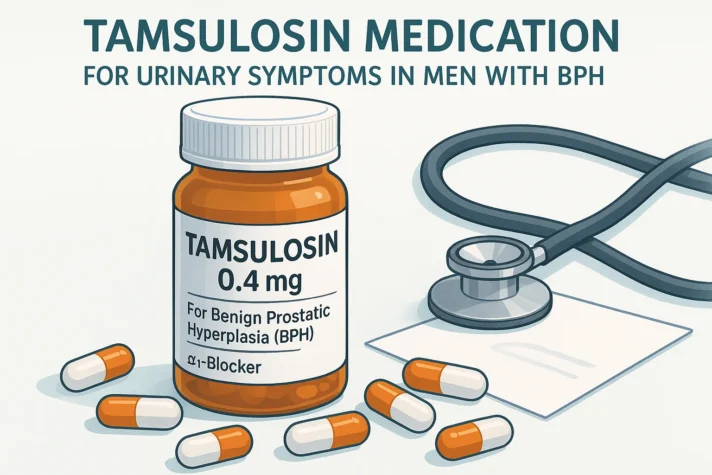
Tamsulosin is mainly prescribed for benign prostatic hyperplasia (BPH), a condition where the prostate enlarges and causes urinary problems. However, studies suggest it may also indirectly help with erectile dysfunction (ED), especially in men who have both BPH and ED. By relaxing smooth muscles and improving blood flow in the pelvic region, tamsulosin can enhance erection quality and sexual satisfaction. It’s not a substitute for medications like Viagra or Cialis but may complement them under medical supervision. Always consult your doctor before combining treatments to ensure safety and effectiveness for your individual health needs.
Read more
If you’re one of the many men juggling both benign prostatic hyperplasia (BPH) and erectile dysfunction (ED), you know how frustrating it can be to manage both issues at once. While medications like Viagra and Cialis are the go-to treatments for ED, have you ever wondered if something like tamsulosin usually prescribed for BPH, could play a role in improving your sexual health too? Though not primarily designed for ED, recent studies suggest that tamsulosin might offer some surprising benefits for men dealing with both BPH and ED.
In this article, we’ll dive into how tamsulosin works, its potential impact on erectile function, and what you should know about combining it with other treatments. Could this BPH medication actually help you get back to feeling like yourself? Let’s explore!
Allo asks
Have you ever heard that Tamsulosin (for BPH) might also improve erectile function?
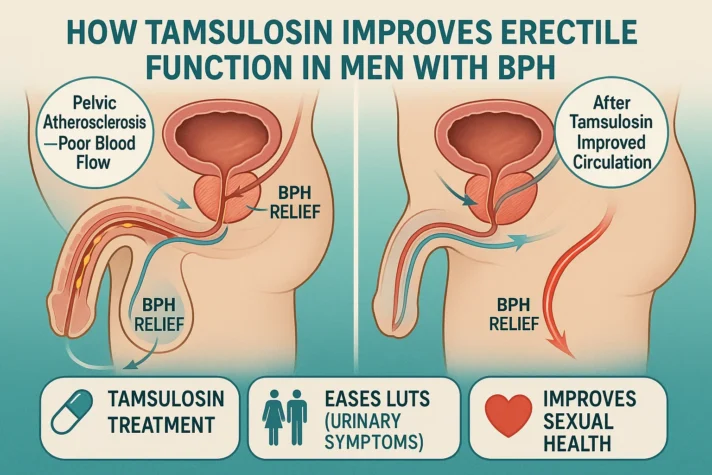
Studies show that tamsulosin may improve erectile function in men with ED linked to BPH and pelvic atherosclerosis ( buildup of plaque made up of fat, cholesterol, and other substances in the arteries that supply blood to the pelvic region). This improvement is likely due to tamsulosin helping to ease lower urinary tract symptoms (LUTS) caused by BPH, which can also improve sexual health.[1]
Research suggests that tamsulosin might help relax smooth muscle in the erectile tissue of the penis (corpus cavernosum), leading to better erections.[2]
Tamsulosin may help improve blood flow to the penis by affecting two key areas:
Cavernosal sinus: This is part of the erectile tissue in the penis, where blood fills up during an erection. Better blood flow here means stronger erections.
Arteriolar tree: These are small arteries that carry blood to the space in the penis (cavernosal sinus). Tamsulosin may help relax these blood vessels, making it easier for blood to flow into the penis.
This action may involve nitric oxide pathways and cyclic guanosine monophosphate (cGMP), similar to how PDE5 inhibitors (like Viagra and Cialis) work. Tamsulosin is not a substitute for ED treatments like sildenafil (Viagra) or tadalafil (Cialis).
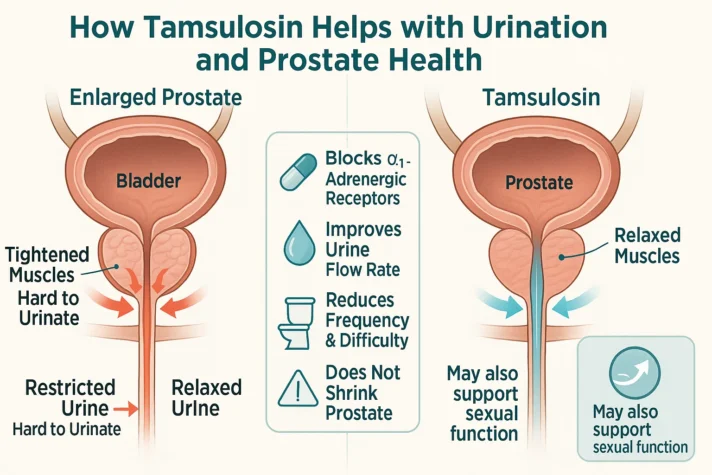
Tamsulosin is a medicine often used to help people who have trouble urinating due to an enlarged prostate (a common issue for older men). The prostate is a small gland near the bladder, and when it gets bigger, it can press on the bladder and the urethra (the tube that carries urine out of the body). This pressure can make it hard to urinate.
Inside your body, there are special receptors on the muscles of your prostate and bladder. These receptors are called α1-adrenergic receptors. When these receptors are activated, they cause the muscles to tighten or contract. This tightening can make it harder for urine to flow through.
Tamsulosin works by blocking these α1-adrenergic receptors. When these receptors are blocked, the muscles in the prostate and bladder relax. This helps open up the passage for urine, making it easier to urinate.
Symptoms Tasulosin Helps With:
Frequent urination
Difficulty starting urination
Weak urine stream
Common in men with benign prostatic hyperplasia (BPH) and bladder outlet obstruction.
How Tasulosin Improves Urination:
Improves urine flow and urinary flow rate.
Reduces postvoid residual urine volume (leftover urine after urination).
Limitations:
Tamsulosin doesn’t shrink the prostate.
It only treats the symptoms of BPH, not the actual condition.
Additional Benefits:
Improves overall quality of life by relieving urinary tract issues.
May indirectly benefit sexual function due to the connection between urinary and sexual health (especially related to blood flow to the pelvic area).
Tamsulosin’s Impact on Sexual Function
Tamsulosin is mainly used to treat BPH-related urinary symptoms. It’s measured by the International Prostate Symptom Score [3], Danish Prostate Symptom Score [4], and Boyarsky symptom scores [5].
For men with both ED (erectile dysfunction) and BPH, tamsulosin can improve:
Erectile function
Intercourse satisfaction
Sexual satisfaction
Orgasmic function
Clinical trials show that tamsulosin leads to significant improvements in International Index of Erectile Function (IIEF) scores and IIEF-5 scores, especially in:
Sexual satisfaction
Erectile quality (measured by Erection Hardness Score) [2]
Side Effects:
Ejaculatory dysfunction (e.g., reduced or absent ejaculation) can occur, especially at higher doses, and may cause ejaculation bother.
Low blood pressure
Dizziness
Intraoperative Floppy Iris Syndrome during cataract surgery.
“If you’re experiencing side effects like ejaculatory dysfunction or dizziness from tamsulosin, we can adjust the dosage or consider other treatments to improve both your urinary and sexual health.”
Differentiating BPH-Related ED and Other Causes of ED
Condition
Cause
Treatment for ED
Treatment for BPH
Notes
BPH-related ED
An enlarged prostate affects both urination and erections.
Tamsulosin helps with erections.
Tamsulosin, 5α-reductase inhibitors, and surgery
Diagnosed with a rectal exam or ultrasound.
Vascular ED
Poor blood flow to the penis (heart issues, atherosclerosis).
Viagra or Cialis for better erections.
Treat heart problems, not BPH.
Blood flow problems need heart-related treatment.
Hormonal ED
Low testosterone or other hormonal issues.
Testosterone therapy.
Tamsulosin won’t fix hormonal problems.
Check hormones with a PSA test.
Psychological ED
Stress, anxiety, or depression.
Therapy or Viagra for quick relief.
Tamsulosin won’t help here.
Therapy helps with mental health issues.
Neurological ED
Nerve issues (e.g., spinal injury).
Viagra, injections for erections.
Tamsulosin won’t treat nerve issues.
Nerve-related treatments might be needed.
Other ED (e.g., Kidney Stones)
Non-BPH causes like kidney stones or other diseases.
Viagra or Cialis for erections.
Tamsulosin isn’t effective here.
Treat kidney stones separately.
Combining Tamsulosin and PDE5 Inhibitors for ED
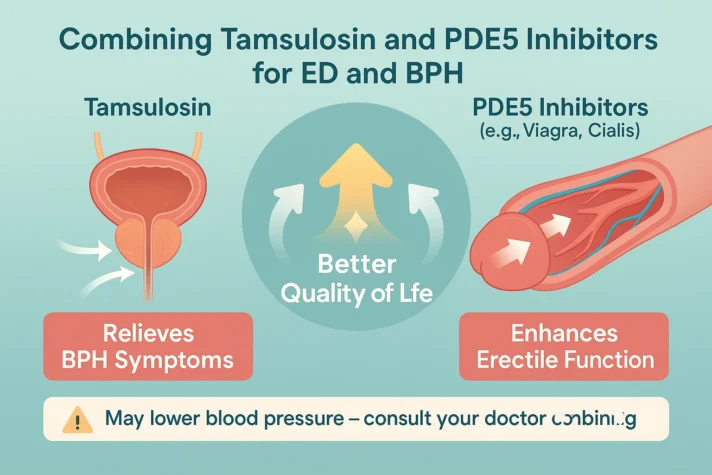
Sometimes, doctors combine tamsulosin (for BPH) with a PDE5 inhibitor (like tadalafil or sildenafil) to treat men with both ED and BPH. This combination can improve both erectile function and urinary flow, leading to a better overall quality of life.
Benefits:
Tamsulosin helps with urinary symptoms from BPH.
PDE5 inhibitors (like Viagra or Cialis) help improve erections.
Together, they can provide additive benefits for both sexual and urinary issues.
Cautions:
This combination can lower blood pressure and cause dizziness or fainting, especially when taken together.
Studies and data from the WHO Global Pharmacovigilance Database show these risks.
Always talk to a doctor before combining these medications.
It’s important to ensure the combination is safe and effective for the individual.
Conclusion
If you have both ED and BPH, it’s vital to consult with your healthcare provider to explore treatment options. A doctor can assess your unique situation and recommend the most appropriate course of action, which may include medications such as tamsulosin or PDE5 inhibitors, or a combination of both. When discussing sexual health with your doctor, be sure to address concerns about ejaculatory function and any other potential adverse effects associated with tamsulosin. Open and honest conversations will help ensure that you receive a treatment plan that improves your sexual health while managing your urinary symptoms.
"The following blog article provides general information and insights on various topics. However, it is important to note that the information presented is not intended as professional advice in any specific field or area. The content of this blog is for general educational and informational purposes only.
Book consultation
The content should not be interpreted as endorsement, recommendation, or guarantee of any product, service, or information mentioned. Readers are solely responsible for the decisions and actions they take based on the information provided in this blog. It is essential to exercise individual judgment, critical thinking, and personal responsibility when applying or implementing any information or suggestions discussed in the blog."
Read more
Most Asked Questions
Is tamsulosin a substitute for Viagra or Cialis?
No, tamsulosin is not a direct substitute for Viagra or Cialis. While it can help with ED in certain cases, it’s not a primary treatment for erectile dysfunction. PDE5 inhibitors are more effective for improving erections.
How does tamsulosin work for urinary symptoms in BPH?
Tamsulosin works by relaxing the muscles in the prostate and bladder neck, making it easier for urine to flow and reducing symptoms like frequent urination and weak urine stream.
What is the connection between BPH and erectile dysfunction?
BPH can affect both urination and erections. The enlargement of the prostate may disrupt blood flow and nerve function, contributing to erectile dysfunction. Treating BPH with tamsulosin can sometimes improve sexual function as well.
How long does it take for tamsulosin to work?
Tamsulosin typically starts working within a few days to a week to relieve urinary symptoms. Its effects on erectile function may take longer and vary from person to person.
What should I do if I experience side effects from tamsulosin?
If you experience side effects like dizziness, ejaculatory problems, or low blood pressure, it’s essential to talk to your doctor. They may adjust your dosage or recommend an alternative treatment.
This article was written by Dr. Sharon Kumar, who has more than 2 years of experience in the healthcare industry.
Allo has the expertise of over 50+ doctors who have treated
more than 1.5 lakh patients both online and offline across
30+ clinics.
Our mission is to provide reliable, accurate, and practical health information to help you make informed decisions.
For This Article
We reviewed over 20 top-ranking articles on erectile dysfunction (ED) and benign prostatic hyperplasia (BPH) treatments to ensure our content is both thorough and up-to-date. Our research is backed by peer-reviewed studies, including clinical trials and research papers published in reputable medical journals, to offer accurate, science-based insights.
We consulted medical textbooks and resources from top institutions, such as the Mayo Clinic and the National Institutes of Health (NIH), to deepen our understanding of the relationship between tamsulosin, ED, and BPH.
Our team actively follows health-related conversations across social media platforms like Twitter, Instagram, and Reddit to keep track of the latest discussions, concerns, and real-world user experiences.
We interviewed medical professionals and reviewed expert opinions to provide trustworthy, patient-friendly advice about treatment options, including tamsulosin and ED medications.