Laser Treatment for Erectile Dysfunction: Benefits and Risks
Written by Dr. Sharon Kumar

With a strong academic background in dentistry and clinical exposure, Dr. Sharon who has studied at PDM Dental College, brings a valuable blend of medical knowledge and communication skills to health content writing. She is passionate about creating clear, compassionate, and evidence-based content on topics such as general wellness, sexual health, oral care, and patient education. Her goal is to make complex medical information easy to understand, relatable, and genuinely helpful for readers seeking clarity on their health concerns. Dr. Sharon believes in the power of well-researched, empathetic content to educate and empower people to make better health decisions. Whether it’s writing about preventive care or breaking down myths in sexual wellness, her content always balances science with sensitivity.
•
July 30, 2026
Our experts continually monitor the health and wellness space, and we update our articles when new information becomes available.
Quick Read
Laser treatment for erectile dysfunction is a painless, non-surgical therapy that uses gentle light energy to improve blood flow, repair tissues, and restore natural erections. It works by stimulating cellular activity and encouraging new blood vessel growth in the penis. Unlike pills that give temporary relief, laser therapy targets the root cause of ED: poor circulation, nerve damage, or tissue weakness. It’s safe, drug-free, and suitable for men with mild to moderate ED. Minor redness or warmth may occur, but serious side effects are rare. In India, treatment cycles typically cost between ₹25,000 and ₹50,000.
Struggling with erection problems and tired of relying on pills? You’re not alone, and there’s some good news. Laser treatment for erectile dysfunction is becoming one of the most talked-about new options for men’s sexual health. It’s completely painless, non-surgical, and helps improve blood flow and nerve health in the penis using gentle light energy. In simple words, it helps your body heal itself naturally. Unlike medicines that give only short-term relief, laser therapy aims to fix the root cause of ED over time. In this guide, we’ll explain how the treatment works, its benefits, safety, cost, and what to expect if you’re considering it.
ED and Laser Therapy
Erectile dysfunction (ED) is the inability to achieve or maintain an erection sufficient for sexual activity, a condition that can arise from both physical and psychological causes, or a combination of both. While ED can affect men at any age, its prevalence increases with age and is related to underlying health conditions such as diabetes, heart disease, and constant stress. These factors can disturb the blood flow, damage nerve function, and disrupt hormonal balance, all of which are critical for achieving and maintaining an erection.
What makes laser treatment exciting is that it’s safe, painless, and focuses on restoring natural function instead of just managing symptoms.”
In response to these challenges, laser therapy for erectile dysfunction has emerged as a promising solution — alongside regenerative options like stem cell therapy for ED. Using photobiomodulation (PBM), low-level lasers stimulate
- Tissue regeneration
- Enhance blood circulation
- Reduce oxidative stress ( imbalance between the production of harmful molecules that can damage cells).
By promoting better blood flow, laser therapy works to improve erectile function over time. Unlike traditional treatments, which often focus on managing symptoms, laser therapy offers a non-invasive and painless approach to addressing the underlying causes of ED, making it an increasingly popular option for men seeking a natural, drug-free way to improve their sexual health. Through its regenerative effects, laser therapy holds the potential to restore natural erectile function and offer a more sustainable solution for men with ED.
How Laser Therapy Works for ED
- Laser therapy for erectile dysfunction (ED) operates through a process called photobiomodulation (PBM).
- This involves using light energy to stimulate the body’s cells and promote natural healing and tissue repair.
- The light from the laser penetrates the skin, reaching deeper tissues in the penis.
- It works by enhancing mitochondrial function [1], which is key to producing energy for cells.
- This increased energy supports better blood vessel growth, reduced oxidative stress, and overall tissue regeneration, all of which help restore normal erectile function.
1. Enhancing Blood Vessel Functions
- One of the key benefits of low-level laser therapy (LLLT) for ED is its ability to improve blood flow.
- When ED is caused by poor circulation, which is often seen in men with diabetes or as a part of the aging process, the laser helps to generate new blood vessels.
- This process is important for improving circulation to the penis, making it easier to achieve and maintain an erection.
- Clinical studies have shown that LLLT can help form new vascular or blood pathways, increasing blood flow and thus improving erectile function.[2]
2. Promoting Tissue Regeneration
- The erectile tissue (corpus cavernosum) in the penis plays a central role in achieving an erection.
- Laser therapy helps to regenerate and repair this tissue, improving its elasticity and responsiveness.
- As a result, men experience stronger and longer-lasting erections.
- Improvements are also seen in the Erection Hardness Score (EHS) [3], which measures the firmness of an erection, showing that laser therapy can lead to better erectile performance.
3. Neurovascular Regeneration
- For men whose ED is caused by nerve damage (such as from diabetes or after prostate surgery), laser therapy offers the potential for neurovascular regeneration.
- This means that the therapy helps repair the nerves responsible for controlling the erection process.
- By supporting the healing of nerve tissues, laser therapy can help improve sexual performance, sensitivity, and overall erectile function.
4. Reducing Oxidative Stress and Producing Nitric Oxide
- Another way laser therapy benefits ED is by reducing oxidative stress, the damage caused by harmful molecules called reactive oxygen species (ROS) [4].
- The therapy stimulates the mitochondria [1] in cells, boosting the production of energy produced by the cell (ATP), which is important for tissue repair.
- This process helps lower the levels of ROS and supports better cell function, especially in men with diabetes or other conditions that increase oxidative stress.
- Laser therapy also promotes the production of nitric oxide, a molecule that helps relax blood vessels, further enhancing blood flow to the penis and supporting erections.
5. The Role of eNOS and nNOS
- The production of nitric oxide is critical for maintaining an erection, as it helps relax the blood vessels in the penis.
- There are two main types of nitric oxide synthase (NOS) enzymes involved in this process: endothelial nitric oxide synthase (eNOS) and neuronal nitric oxide synthase (nNOS).
- Laser therapy stimulates both of these enzymes, which improves the relaxation of blood vessels and, in turn, enhances erectile function.
- By boosting the production of nitric oxide, laser therapy helps restore and maintain healthy erectile function.
Types of Laser Treatment for ED
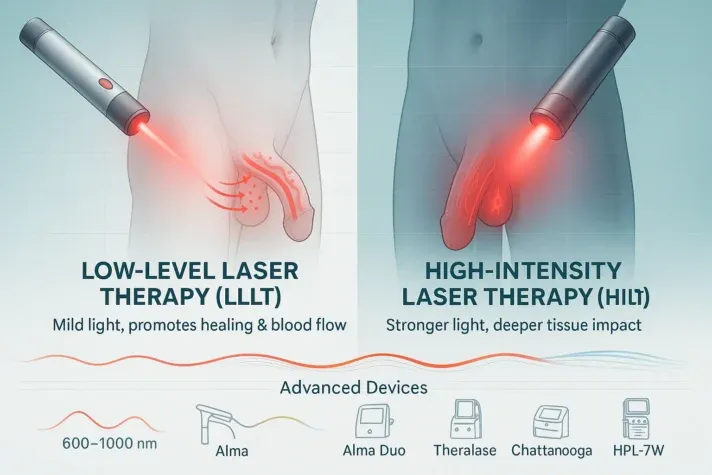
There are two main types of laser therapy used to treat erectile dysfunction (ED): Low-Level Laser Therapy (LLLT) and High-Intensity Laser Therapy (HILT) — often compared with shockwave therapy for ED. Both therapies work by improving blood flow and encouraging tissue regeneration, but they differ in intensity and the types of cases they are used for.

1. Low-Level Laser Therapy (LLLT)
- Low-Level Laser Therapy (LLLT) uses low-intensity light to stimulate the body's natural healing processes without causing harm to the tissues.
- Devices like the Theralase laser and the Chattanooga HPL-7W are designed to deliver gentle doses of light energy, which help improve erectile function by enhancing blood flow and promoting tissue repair.
- LLLT is effective for treating mild to moderate cases of ED and is non-invasive, making it a popular choice for patients looking for a drug-free, pain-free solution.
2. High-Intensity Laser Therapy (HILT)
- High-Intensity Laser Therapy (HILT) uses more powerful lasers compared to LLLT and is generally reserved for severe ED cases.
- While both LLLT and HILT promote blood flow and help regenerate tissues, HILT may provide faster results due to its higher energy output.
- However, HILT requires careful control of the parameters to ensure that it’s effective and safe for the patient.
- It's often used for more advanced cases where other treatments may not have been as successful.
3. Specific Devices: The Alma Duo Laser
- The Alma Duo laser is an advanced device that combines shockwave therapy with low-level laser therapy (LLLT) to offer a more comprehensive treatment for ED.
- This dual-action approach targets the penile tissue, combining the benefits of both therapies to improve blood circulation, stimulate tissue repair, and increase overall erectile function.
- The Alma Duo and similar laser devices represent the latest in men's health technology, providing precise and targeted treatment for ED.
4. Crucial Laser Parameters
- The effectiveness of laser therapy for ED depends on key parameters, including wavelength, joules, and watts. All these are energy units.
- These factors determine how deeply the light can penetrate the tissue and how much energy is delivered to the affected areas.
- For optimal results, wavelengths between 600–1000 nm are most commonly used, with both red and infrared wavelengths showing positive effects.
- Near-infrared laser therapy, often delivered using diode laser technology, is particularly effective because it can penetrate deeply into the corpus cavernosum, the erectile tissue responsible for achieving an erection.
Patient Experience with Laser Therapy for ED
Laser therapy is ideal for men with mild to moderate erectile dysfunction (ED), often caused by poor blood circulation or tissue damage. To determine if you're a good candidate, healthcare providers will perform a physical examination and may order blood tests. They also use tools like the International Index of Erectile Function (IIEF) to assess your baseline erectile function and track your progress throughout the treatment.
Treatment Procedure
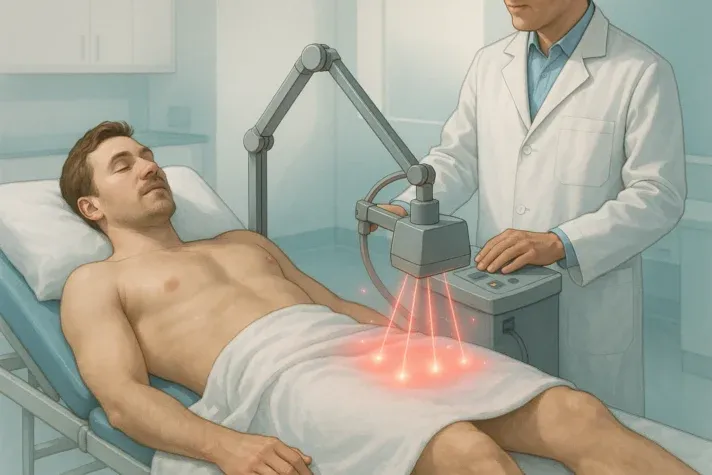
- During the laser therapy session, patients typically lie on their back in a supine position while the laser equipment directs light energy onto the penis.
- The treatment lasts around 20-30 minutes, and there's no need for anesthesia [5], making it much more comfortable compared to other procedures like prostate laser surgery, which requires general anesthesia or spinal anesthesia. Most patients find the procedure painless and relaxing.
Anticipating Results
- You will likely start seeing improvements after about 6–8 sessions.
- As the treatment progresses, many men notice better erection quality, enhanced sexual performance, and increased sensitivity.
- Your progress can be measured using tools like the Erection Hardness Score and International Index of Erectile Function, both of which generally improve over the course of the treatment.
Safety and Side Effects
- One of the best things about laser therapy is its safety and non-invasive nature.
- It has very few side effects.
- Some men might experience mild redness or warmth in the treated area, but this usually goes away within a few hours.
- Unlike oral ED medications, laser therapy doesn't have systemic side effects or any interaction with medications like blood thinners.
Post-Treatment Care
- After laser therapy, there is no special aftercare required.
- You can resume your normal daily activities immediately, including sexual activity.
- To maintain the long-term benefits of the treatment, some patients choose to continue with regular maintenance sessions.
- These help ensure sustained sexual wellness and long-lasting results.
Comparison of ED Treatments
Treatment
Laser Therapy
Oral Medications

Shockwave Therapy
Vacuum Devices & Implants
How It Works
Uses light to improve blood flow & tissue.
Increases blood flow with pills.
Uses sound waves to boost blood flow.
Creates an erection or implants.
Benefits
Treats root causes naturally.
Quick but temporary results.
Improves blood flow, non-invasive.
Quick fix or permanent solution.
Side Effects
Few, mild redness or warmth.
Headaches, dizziness.
Mild discomfort post-treatment — similar to what patients report after PRP shot for ED.
Bruising or surgical risks.
Ideal For
Men with mild to moderate ED.
Quick solution, no surgery.
Blood flow issues, non-invasive.
Severe ED or long-term solution.
Recovery
No downtime.
No recovery needed.
Short rest needed.
Immediate (vacuum), surgery (implants).
Long-Term Effect
Heals and improves function.
Temporary relief.
Improves blood flow, not tissue.
Quick or permanent, no tissue healing — for a full overview of options, see this ED treatment guide.
Considerations for Laser ED Treatment
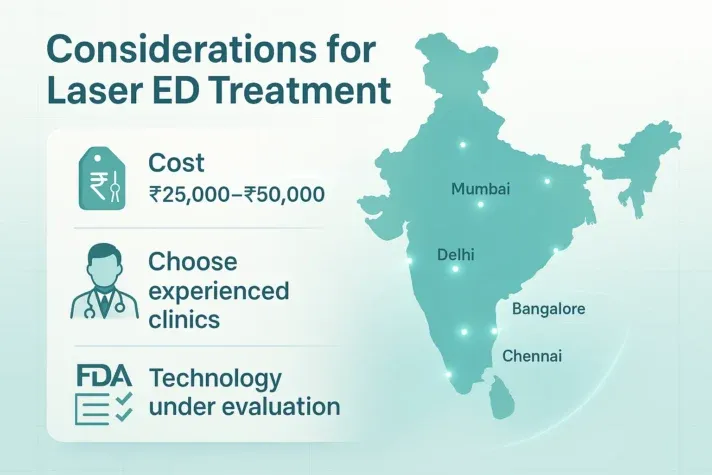
- The out-of-pocket cost varies by location and clinic. In India, treatment cycles cost ₹25,000 to ₹50,000. The Food and Drug Administration continues evaluating these technologies.
- Laser therapy is available in many Indian clinics, especially in larger cities. Choose clinics with experienced professionals providing personalized treatment.
- Laser technology extends beyond ED treatment. Procedures like photoselective vaporization of the prostate, holmium laser ablation of the prostate, and holmium laser enucleation of the prostate treat benign prostatic hyperplasia and urinary tract infections affecting the prostate gland.
- While serving different purposes, they demonstrate laser technology's versatility in men's health. Concerns about side effects on seminal fluid or blood clots generally don't apply to ED-focused laser therapy.
Conclusion
Laser treatment offers a non-invasive, safe, and effective solution for improving sexual health. By stimulating blood flow, regenerating tissue, and reducing oxidative stress, it addresses ED's underlying causes rather than masking symptoms. Unlike vascular reconstruction surgery or other surgical options, it offers a gentler restoration path. Consult qualified healthcare professionals before pursuing laser therapy. They determine suitability through proper evaluation, including Masson staining analysis when needed, guiding you toward the best treatment plan. While clinical studies show promise, individual patient outcomes vary, making personalized approaches to sexual wellness essential for optimal results.
Disclaimer
The following blog article provides general information and insights on various topics. However, it is important to note that the information presented is not intended as professional advice in any specific field or area. The content of this blog is for general educational and informational purposes only. The content should not be interpreted as endorsement, recommendation, or guarantee of any product, service, or information mentioned. Readers are solely responsible for the decisions and actions they take based on the information provided in this blog. It is essential to exercise individual judgment, critical thinking, and personal responsibility when applying or implementing any information or suggestions discussed in the blog.
Most Asked Questions
Is laser therapy better than Viagra or oral medications?
Unlike pills that give short-term results, laser therapy targets the root cause of ED by improving blood flow and tissue health naturally.
How much does laser treatment for ED cost in India?
In India, a full cycle of laser treatment costs ₹25,000 to ₹50,000, depending on the clinic, equipment, and number of sessions.
Who is the best candidate for this treatment?
Men with mild to moderate ED due to poor blood flow, diabetes, or age-related factors are ideal candidates.
Can I resume normal activities after laser therapy?
Yes, there’s no downtime. You can return to your daily activities even sexual activity immediately after treatment.
Is laser treatment painful?
No, laser therapy is completely non-invasive and painless. Most men describe it as a mild warming sensation on the skin.
Sources
- 1.
The role of mitochondrial function and cellular bioenergetics in ageing and disease
- 2.
Photobiomodulation as a Potential Therapy for Erectile Function: A Preclinical Study in a Cavernous Nerve Injury Model
- 3.
The erection hardness score and its relationship to successful sexual intercourse
- 4.
ROS: Basic Concepts, Sources, Cellular Signaling, and its Implications in Aging Pathways