Dental Dams: What They Are, How to Use Them, and Practical Alternatives
Written by Dr. Paavas Sharma

Dr. Paavas Sharma holds a Bachelor's degree in Dental Surgery from Manipal Academy of Higher Education. In her journey, she has garnered numerous accolades for her creative writing. Proficient in both English and Hindi, she particularly enjoys delving into topics related to sexual and dental health and possesses experience in writing about oncology. Dr. Paavas has 3 years of professional writing experience and was also involved in editorial teams for magazines since her school and college days. Apart from writing she consistently seeks opportunities for personal expression and enjoyment, whether it's cooking, Netflix sessions or indulging in crafts.
•
January 20, 2026
Our experts continually monitor the health and wellness space, and we update our articles when new information becomes available.

Quick Read
Dental dams are thin barrier sheets that help reduce the risk of STIs during oral sex by preventing direct contact with bodily fluids. They are recommended by health authorities but are not easily available in India. When used correctly, they offer added protection, though they do not eliminate risk completely. If a dental dam is not available, a properly cut condom is a safe and practical alternative. Safer sex is about lowering risk while still keeping intimacy comfortable and informed.
Oral sex is often seen as “safe sex,” but the truth is that sexually transmitted infections (STIs) can still spread through oral contact. A dental dam is one simple way to reduce this risk. However, many people in India have never heard of it or do not know how to use one.
This guide explains what a dental dam is, how it works, how to use it correctly, whether it is available in India, and what you can use instead if you do not have one.
What Is a Dental Dam?
A dental dam is a thin, flexible sheet usually made of latex or polyurethane or non-latex polyisoprene (for people with latex allergies). It is placed between the mouth and a partner’s vulva or anus during oral sex.[1] Dental dams work like flavoured condoms, designed as a barrier for safe oral sex.
Dental dams were first used in dentistry, which is where the name comes from. Over time, they became a recommended safer sex barrier for oral-vaginal and oral-anal contact.
[show_survey question_id="1"]

Why Use a Dental Dam During Oral Sex?
Oral sex has a lower risk of STI transmission compared to vaginal or anal sex, but the risk is not zero.
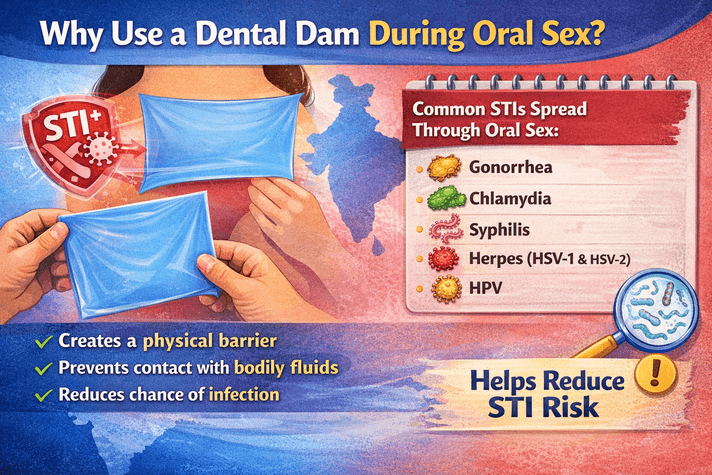
STIs[2] that can spread through oral sex include:
- Gonorrhoea
- Chlamydia
- Syphilis
- Herpes (HSV-1 and HSV-2)
- HPV
Many infections, especially in the throat, show no symptoms, so partners may unknowingly spread them.
A dental dam helps by:

- Creating a physical barrier
- Preventing contact with bodily fluids like saliva, vaginal fluids, blood, or anal fluids
- Reducing the chance of infection passing from one person to another
It does not guarantee complete protection, but it can reduce risk, especially when used correctly.
What Does Medical Research Say About Dental Dams?
Medical research on dental dams shows limited direct studies measuring their impact on STI rates during oral sex, a gap acknowledged by experts. However, the available evidence supports their role as a useful barrier method. They work on the same basic principle as condoms, by creating a physical barrier that reduces contact with bodily fluids. This barrier-based approach is a well-accepted method for lowering STI risk.
What Do Health Authorities Recommend?
The Centers for Disease Control and Prevention (CDC)[3] recommends dental dams for oral-vaginal and oral-anal sex and provides clear guidance on correct use.
The American Sexual Health Association (ASHA)[4] states that although oral sex carries a lower risk than vaginal or anal sex, barrier methods like dental dams can further reduce STI risk.
Sexual health and dermatology experts[5] note that dental dams may be particularly useful for people with multiple partners, unknown partner STI status, or higher exposure risk.
How Does a Dental Dam Work?
A dental dam works by blocking direct contact between the mouth and sensitive skin or mucosal areas.
Think of it as:
- Condom → for penetrative sex
- Flavoured condom → for oral sex
- Dental dam → for oral sex
For effective use they must:
- Fully cover the vulva, anus, or the intended area without any gaps
- Be secured firmly to prevent slipping during movement
- Be inspected beforehand for any tears. Avoid actions causing tears or shifts.
- Be used consistently and in a correct manner
How to Use a Dental Dam (Step-by-Step)
Here is a step by step guide about how to use dental dam:
- Wash your hands before opening the pack
- Check the dental dam for holes or tears
- Place it flat over the vulva or anus
- Make sure it covers the area completely
- You can add a water-based or silicone-based lubricant on the side facing the body
- Hold it in place during oral sex
- Do not flip or reuse the same dam
- Throw it away after one use
Important things to avoid:
- Do not use oil-based lubricants (they weaken latex)
- Do not stretch the dam tightly
- Do not reuse or wash it for later use
Are Dental Dams Available in India?
Dental dams are not commonly sold in Indian pharmacies, unlike condoms. In India, the awareness about dental dams is low and they are hard to find online. However, they may be available online on sexual wellness websites or international websites, or at some sexual health clinics. Because of limited availability, many people use safe alternatives, which are explained below.
What Can You Use Instead of a Dental Dam?
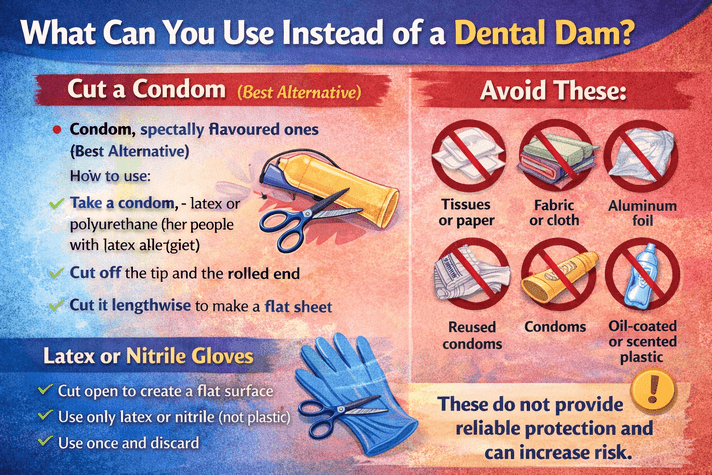
If a dental dam is not available, some barrier alternatives can be used.
Condom, specially flavoured ones (Best Alternative)
This is the most practical option in India.
How to use:
- Take a condom - latex or polyurethane (for people with latex allergies)
- Cut off the tip and the rolled end
- Cut it lengthwise to make a flat sheet
Why this works:
- Condoms are easy to find
- They use the same barrier principle
- Protection is similar when used correctly
Latex or Nitrile Gloves
- Cut the glove open to create a flat surface
- Use only latex or nitrile (not plastic)
- Use once and discard
What Should You NOT Use?
- Tissues or paper
- Fabric or cloth
- Aluminium foil
- Reused condoms
- Oil-coated or scented plastic
These do not provide reliable protection and can increase risk.
Bottom Line
Oral sex is not completely risk-free. Dental dams are a simple barrier method that can reduce the risk of STI transmission during oral sex.
In India, dental dams may be hard to find, but condoms used correctly are a safe and accessible alternative. Safer sex is about reducing risk, not fear or shame—and protection does not mean less intimacy.

Disclaimer
The following blog article provides general information and insights on various topics. However, it is important to note that the information presented is not intended as professional advice in any specific field or area. The content of this blog is for general educational and informational purposes only. The content should not be interpreted as endorsement, recommendation, or guarantee of any product, service, or information mentioned. Readers are solely responsible for the decisions and actions they take based on the information provided in this blog. It is essential to exercise individual judgment, critical thinking, and personal responsibility when applying or implementing any information or suggestions discussed in the blog.
Most Asked Questions
Are dental dams really necessary for oral sex?
Oral sex has a lower risk of STI transmission, but it is not risk-free. Dental dams add an extra layer of protection by reducing direct contact with bodily fluids and sensitive skin.
Can dental dams completely prevent STIs?
No. Dental dams reduce risk but do not provide 100% protection. Their effectiveness depends on correct use, full coverage, and using a new dam each time.
Are dental dams available easily in India?
Dental dams are not commonly sold in Indian pharmacies. They may be available online on sexual wellness websites or at some sexual health clinics.
What is the best alternative if I don’t have a dental dam?
A condom cut open lengthwise is the most practical and accessible alternative in India. When used properly, it works on the same barrier principle as a dental dam.
Can I reuse a dental dam after washing it?
No. Dental dams are meant for single use only. Reusing or washing them increases the risk of tears and reduces protection.
Sources
Why Should You Trust Us?
Why Should You Trust Us?
This article was written by Dr. Paavas Sharma, who has more than 4 years of experience in the healthcare industry.
Allo has the expertise of over 50+ doctors who have treated more than 1.5 lakh patients both online and offline across 30+ clinics.
Our mission is to provide reliable, accurate, and practical health information to help you make informed decisions.
For This Article
- We reviewed 7+ top-ranking global and India-specific articles on dental dams and safer oral sex to ensure this guide is accurate, relevant, and easy to understand.
- We referred to guidance from established sexual health authorities and medical organizations to explain how dental dams work and when they are recommended.
- We analyzed available medical research and expert commentary on barrier methods for oral sex, including studies highlighting both benefits and limitations of dental dams.
- We examined real-world questions and concerns shared by users on forums, blogs, and Q&A platforms to address common doubts around availability, safety, and alternatives in India.