Crisis Support and Helplines: Getting Help Right Now
Written by Dr. Srishti Rastogi

Dr. Srishti Rastogi is a medical writer and healthcare professional dedicated to high-quality patient education and public health awareness. Leveraging her clinical background, she produces deeply researched, evidence-based content for digital health platforms and medical publications. Dr. Srishti’s unique dual perspective as a clinician and communicator allows her to craft content that builds trust and credibility with readers navigating sensitive health topics.
•
August 13, 2026
Our experts continually monitor the health and wellness space, and we update our articles when new information becomes available.
Quick Read
If you are in crisis or thinking about suicide right now, you can call Tele-MANAS on 14416, free and any time of day or night, in many Indian languages. You do not have to explain everything or say the right words. A trained person will simply listen. This page lists free helplines in India, explains what happens when you call, and covers what to do both for yourself and for someone you are worried about. Whatever you are feeling right now is real, but feelings like these can ease with support, and you do not have to get through this momnt alone.
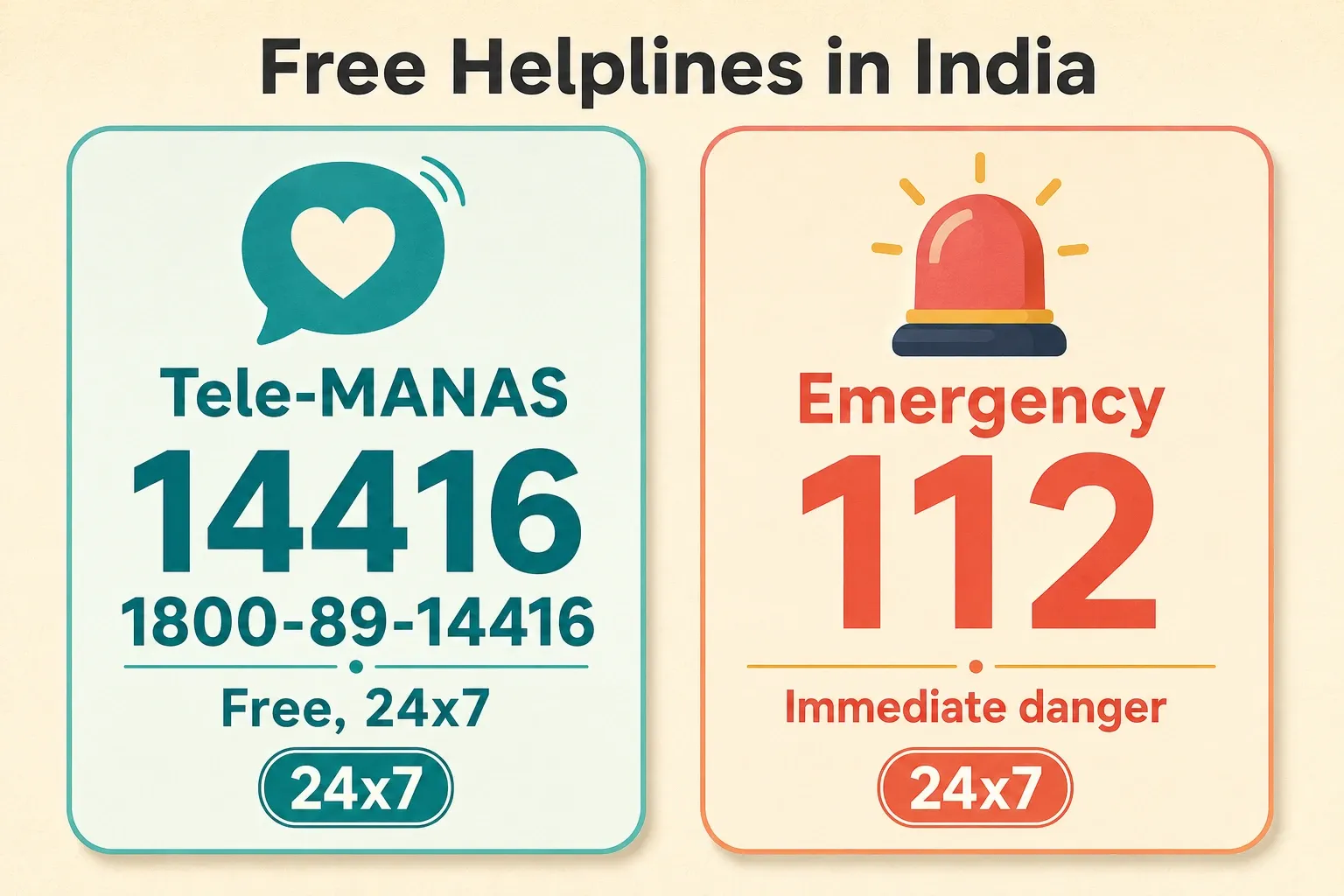
Need help now? Call Tele-MANAS on 14416 (or 1-800-891-4416), a free government helpline available 24 hours a day. If there is immediate danger to life, call 112 or go to the nearest hospital emergency department.
If you are here because everything feels like too much, take a breath. You have already done a brave thing by looking for help. This moment, however heavy, is not the whole story, and the intense feelings you have right now can ease with support.
The most important message on this page is simple: help is available, it is free, and reaching out is a sign of strength, not weakness.

Allo asks
If someone close to you were experiencing a mental health crisis, would you know what to do?
If You Need Help Right Now
If you feel you may harm yourself or cannot stay safe:
- Call 112, India’s free emergency number.
- Go to the nearest hospital emergency department.
- Ask someone you trust to stay with you and help you reach emergency care.
Do not stay alone while you are in immediate danger.
Free Mental Health Helplines in India
| Service | Number | When to use it |
|---|---|---|
| Tele-MANAS | 14416 or 1-800-89-14416 | Free, 24-hour mental health support from the Government of India [1] |
| Emergency Response Support System | 112 | Immediate danger or a medical, police, or fire emergency [3] |
You do not need to be suicidal to call Tele-MANAS. You can call if you feel overwhelmed, distressed, or unable to cope. If you cannot speak privately or prefer writing, the Vandrevala Foundation provides free, 24-hour counselling through WhatsApp at +91 9999 666 555.
What Happens When You Call a Helpline
When you call Tele-MANAS, a trained counsellor will listen and ask what is happening, how you feel, and whether you are safe. You do not need to know exactly what to say. You can begin with, “I’m struggling and need someone to talk to.”
Depending on your needs, the counsellor may provide immediate support, suggest a follow-up, or connect you with mental health services. If language or privacy is important to you, ask what options are available before sharing personal details.
Asking someone directly whether they are thinking about suicide does not put the idea in their mind. A calm, honest question can give them permission to tell you what is really happening.
What If Tele-MANAS Does Not Connect or Did Not Help?
If your call does not connect, try again after a few minutes or use the other Tele-MANAS number. If you spoke to someone but did not get the support you needed, you can:

- Call again and speak with another counsellor.
- Clearly explain whether you need immediate support, help staying safe, or a referral for ongoing care.
- Contact another verified helpline or mental health professional.
- Ask someone you trust to help you find suitable care.
One unsuccessful call does not mean that help will not work. If there is immediate danger, follow the emergency steps at the top of this page instead of waiting for a helpline.
How to Recognise and Help Someone in Crisis
A person may need urgent support if they:
- Talk about wanting to die, feeling hopeless, or being a burden
- Make a suicide plan or search for a way to carry it out
- Give away belongings or say unusual goodbyes
- Withdraw suddenly or show extreme mood changes
- Increase their use of alcohol or other substances
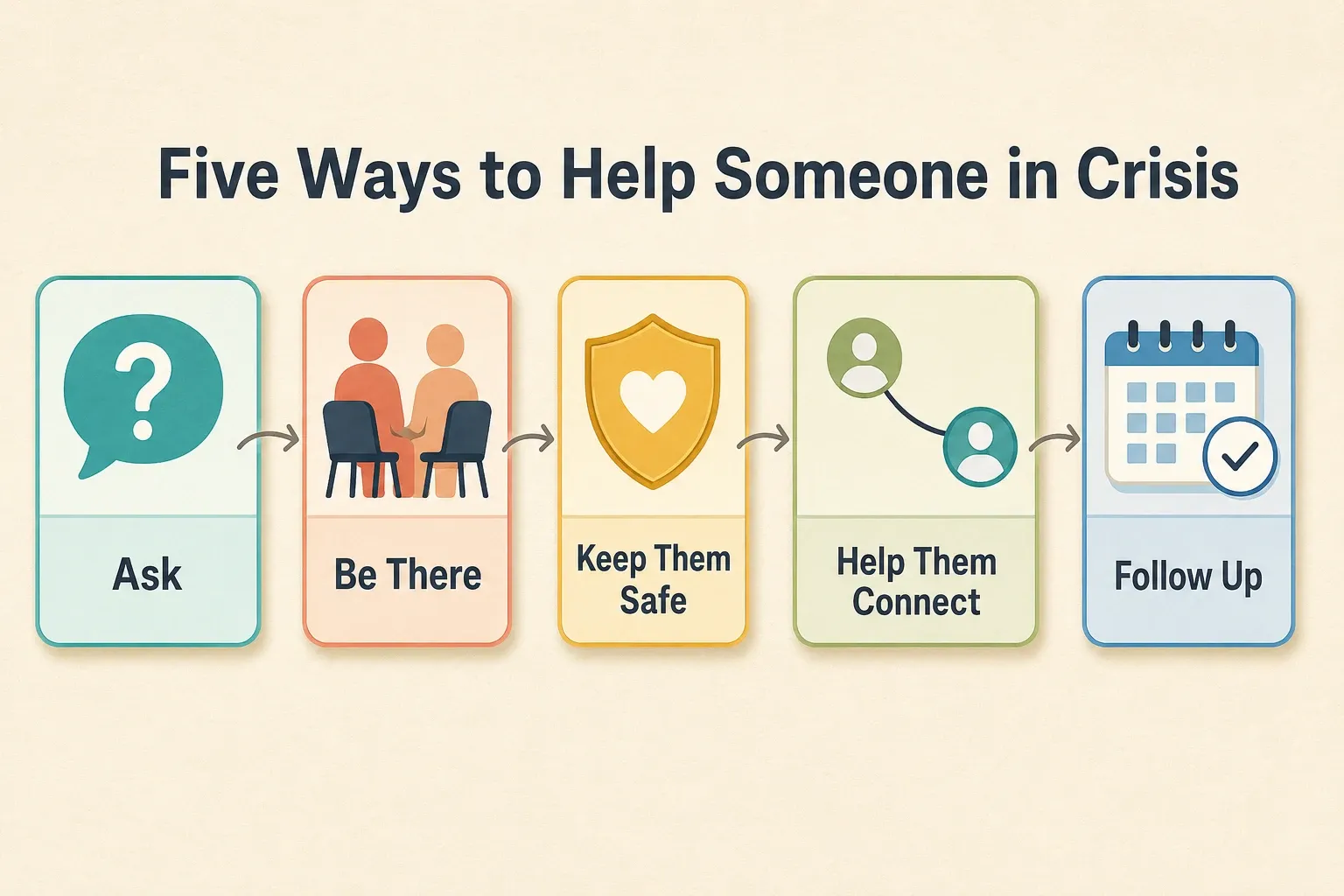
If you notice these signs, follow these steps [4]:
- Ask: Calmly ask, “Are you thinking about suicide?” Asking directly does not put the idea in their mind.
- Listen: Let them speak without judging, arguing, or trying to solve everything.
- Keep them safe: Stay with them and reduce access to harmful items if you can do so safely.
- Connect them to help: Call Tele-MANAS on 14416, their doctor, or another mental health professional together.
- Follow up: Check on them after the immediate crisis.
If they have a plan, have already harmed themselves, or cannot stay safe, call 112 or go to the nearest hospital emergency department. If you are in danger, move to a safe place before calling for help.
Learn more about supporting a loved one.
After the Crisis: Plan for Ongoing Support
Once the immediate danger has passed, arrange a follow-up with a doctor or mental health professional. Discuss what led to the crisis and create a safety plan that includes:
- Your personal warning signs
- Steps that help you feel more stable
- People and services you can contact
- Ways to reduce access to harmful items
Understanding what to expect in therapy may make the next step easier. Conditions linked to suicidal thoughts, including depression, can be treated.

Support Beyond the Crisis
A crisis deserves follow-up, even after the immediate feelings have eased. Ongoing care can help you understand what happened and prepare for future difficult moments.
When you are safe and ready, you can book a confidential consultation with a mental health professional at Allo Health to discuss your next steps. Allo Health is not an emergency service.
Disclaimer
This blog article discusses mental health and emotional wellbeing for general educational and informational purposes only. It is not a substitute for professional advice, diagnosis, or treatment, and only a qualified mental health professional, such as a psychiatrist, psychologist, or licensed therapist, can diagnose a condition or recommend treatment. If you are struggling, please reach out to a qualified professional or someone you trust; if you are in crisis or may be at risk of harming yourself, use the crisis support resources on this page. For any decisions about your mental health, we encourage you to seek the guidance of a qualified professional.
Most Asked Questions
What number do I call for mental health support in India?
Call Tele-MANAS on 14416 or 1-800-891-4416, a free government helpline available 24 hours a day in English and 20 regional languages. KIRAN (1800-599-0019) is another free, 24x7 government helpline. If there is immediate danger to life, call 112 or go to the nearest hospital.
Will I be able to talk to someone in my own language?
Very likely. Tele-MANAS operates in English and more than 20 regional languages, and KIRAN in 13 languages. When you call, you can ask for the language you are most comfortable with, and you will usually be connected accordingly.
Will calling a helpline get me admitted to hospital or involve the police?
Calling Tele-MANAS does not automatically mean that you will be admitted to hospital or that the police will be contacted. The counsellor will usually listen, understand what is happening and discuss appropriate support. Confidentiality may have limits when there is a serious and immediate threat to someone’s life or when disclosure is required by law. You can ask the counsellor to explain these limits at the beginning of the call.
Can I contact a helpline for someone else?
Yes. If you are worried about a friend or family member, you can call a helpline yourself to talk it through and ask how best to support them. You do not have to be the person in distress to reach out.
Is it true that asking someone about suicide makes it more likely?
No. This is a common and harmful myth. Asking someone directly and calmly whether they are thinking about suicide does not plant the idea. According to the NIMH, it often brings relief and opens a path to help [4].
Do I have to be suicidal to call a helpline?
No. You can call if you are struggling, overwhelmed, or simply unable to cope. You do not need to be at breaking point to deserve support.
Sources
- 1.
Tele-MANAS, Ministry of Health and Family Welfare, Government of India.
- 2.
Emergency Response Support System (112), Ministry of Home Affairs, Government of India.
- 3.
National Institute of Mental Health. 5 action steps to help someone having thoughts of suicide.
- 4.
World Health Organization. Suicide (fact sheet).
- 5.
The Live Love Laugh Foundation. Helpline directory.
Why Should You Trust Us?
Why Should You Trust Us?
This article was written by Dr. Srishti Rastogi, who has more than 1 years of experience in the healthcare industry.
Allo has the expertise of over 50+ doctors who have treated more than 1.5 lakh patients both online and offline across 30+ clinics.
Our mission is to provide reliable, accurate, and practical health information to help you make informed decisions.
For This Article
- Information about Tele-MANAS and emergency support was verified using official resources from the Ministry of Health and Family Welfare and India’s Emergency Response Support System.
- Every helpline number and service detail was checked against an official source on [date] and is reviewed regularly for changes.
- The crisis recommendations were checked against guidance from the National Institute of Mental Health and the World Health Organization.
- Information about confidentiality and its limits was reviewed with reference to India’s Mental Healthcare Act, 2017.
- The article follows a safety-first approach, avoiding graphic details, sensational language, unsupported promises and commercial promotion.