Can Fear Cause Arousal?
Written by Dr. Sana Khan

Dr. Sana Khan is a dentist and medical content writer with a degree from Maharashtra University of Health Sciences. With a solid background in clinical research and medical communications, she excels at turning complex health topics into clear, accessible content. Her writing is rooted in accuracy and empathy—especially when covering sensitive health issues—making her a trusted voice in patient education and health awareness.
•
July 30, 2026
Our experts continually monitor the health and wellness space, and we update our articles when new information becomes available.
Quick Read
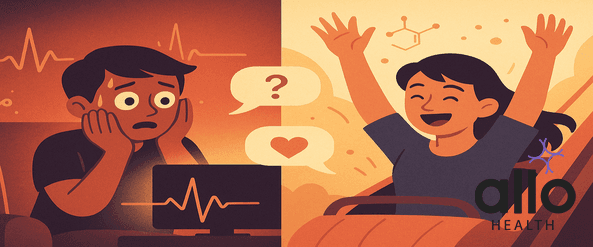
Can Fear Cause Arousal? Yes, fear can sometimes cause arousal, and it’s more common than you think. That’s because your body’s fear and arousal responses share similar physical changes like increased heart rate and heightened alertness. In safe, consensual situations, this can feel exciting. But in traumatic or non-consensual moments, any arousal can feel deeply confusing. Knowing the difference, and understanding that your body’s reactions don’t define your consent or character, is key to making sense of your experience.
Have you ever felt oddly excited during a scary movie or noticed your heart racing in a way that felt arousing? You’re not alone and no, there’s nothing wrong with you. Many people report feeling unexpectedly aroused in situations that also trigger fear. We often think of fear and arousal as opposites, one linked to danger, the other to pleasure. But surprisingly, they can overlap in unexpected ways. In this article, we’ll explore how fear and arousal are connected, how your nervous system reacts to fear, why it can sometimes trigger arousal, and when that response is completely normal or potentially confusing. We’ll also discuss the difference between safe and unsafe situations, and explain why understanding this connection can help you make sense of your body’s signals.
How Can Fear Cause Arousal?
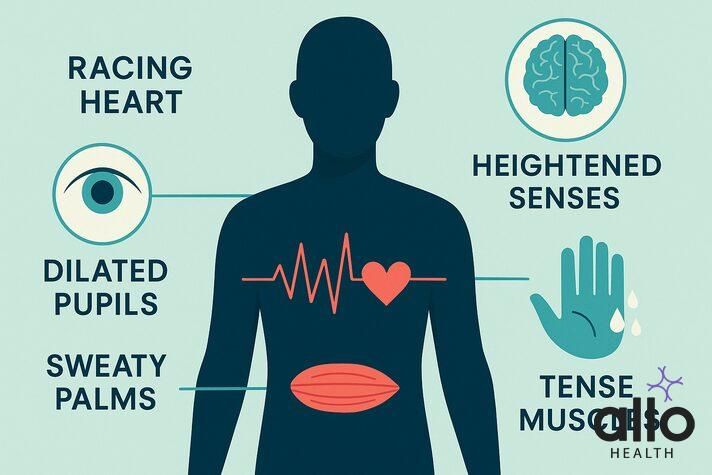
When you're scared, your body kicks into high gear to protect you. This happens because fear activates your nervous system and leads to a hormonal surge in your body (adrenaline, cortisol, dopamine, endorphins), leading to noticeable changes: your heart beats faster, your palms get sweaty, your pupils dilate, your muscles tense up, and your senses become sharper. [1] These reactions prepare your body to deal with a threat, a process often called the "fight or flight" response. Interestingly, these same physiological changes are also involved in sexual arousal (it’s all heightened stimulation!), so it confuses your mind. Sometimes, when your body is already physically aroused due to fear, you might mistake those feelings as coming from something else, like excitement of getting romantically attracted to someone. This confusion is called misattribution of arousal and plays a big role in how we experience emotions in certain situations. A famous study conducted in 1974 showed this clearly - men who had just crossed a scary suspension bridge were more likely to call the woman they met afterward than men who crossed a safer bridge. The excitement they felt was actually fear, but they misinterpreted it as romantic interest. [2] [3]
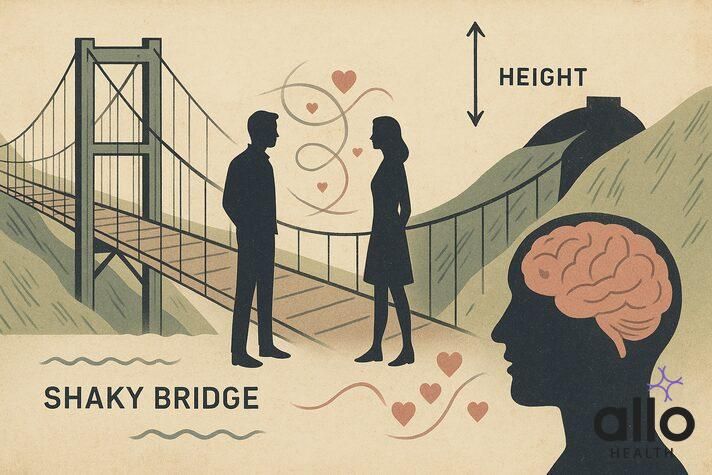
In safe, controlled situations, fear can actually heighten arousal. Your brain knows you’re not in real danger, so it interprets that adrenaline rush as excitement instead of panic.
Can Fear Cause Arousal In Every Situation?
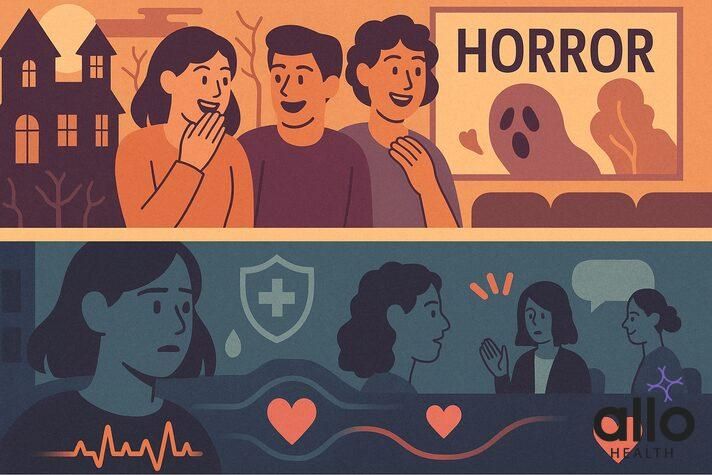
In safe and agreed-upon situations (like watching scary movies, riding roller coasters, or certain sexual activities like BDSM), fear can feel fun and exciting instead of scary. You know you’re not in real danger, so the fear can actually make arousal stronger. But when fear happens in unsafe or non-consensual situations (like during trauma or abuse), any physical arousal is very different. Sometimes, a person’s body reacts even though their mind is not aroused or okay with what’s happening. It feels like your body is saying yes, but your mind is completely against it. This is known as “arousal non-concordance” or simply “unwanted arousal”. This can be very upsetting, confusing, or even make someone feel guilty. [6] That’s why it’s important to understand:
- A physical response is not the same as wanting it (desire) or saying yes (consent).
- The body can respond on its own, and that doesn’t reflect your feelings or mean that something is wrong with your character.
Your nervous system reacts to strong emotions like fear and pleasure in similar ways, it doesn’t always differentiate between the two. That’s why in stressful or exciting moments, some people feel a mix of fear and arousal, which can be confusing. This is completely normal and doesn’t mean something is wrong with you. But if it makes you feel uncomfortable or reminds you of past trauma or abuse, or interferes with your relationships, it’s important to talk to a mental health professional. Therapy can offer clarity, healing, and a safe space to understand your responses.
Disclaimer
The following blog article provides general information and insights on various topics. However, it is important to note that the information presented is not intended as professional advice in any specific field or area. The content of this blog is for general educational and informational purposes only. The content should not be interpreted as endorsement, recommendation, or guarantee of any product, service, or information mentioned. Readers are solely responsible for the decisions and actions they take based on the information provided in this blog. It is essential to exercise individual judgment, critical thinking, and personal responsibility when applying or implementing any information or suggestions discussed in the blog.
Most Asked Questions
Is it normal to feel aroused when I'm scared?
Yes, it's completely normal. Fear and arousal both trigger similar physical responses in the body, so it's possible to feel a mix of both, especially in intense situations.
Can trauma cause arousal?
Sometimes. The body may react physically even when a situation is unwanted or traumatic. This doesn’t reflect desire or consent. Therapy can help process this response.
Does fear-based arousal mean I’m into something wrong?
Not at all. Many people find fear thrilling in certain contexts (like role-play or suspense). What matters is consent, comfort, and emotional safety.
Does feeling aroused during fear mean I wanted it?
No. A physical reaction doesn't mean you gave consent or wanted what happened. The body can respond involuntarily — it doesn’t reflect your thoughts, feelings, or values.
Why does my body react sexually during fearful situations?
Your nervous system can’t always tell the difference between fear and pleasure. Both can cause increased heart rate, hormone surges, and heightened awareness, which might feel like arousal.
Sources
- 1.
Fear and physiological arousal during a virtual height challenge--effects in patients with acrophobia and healthy controls - Journal of Anxiety Disorders
- 2.
Adrenalin Fuels Attraction - The Pennsylvania State University
- 3.
Real-Life Extension of Schachter and Singer (1962) - Psychology of Human Emotion
- 4.
Arousal and Attraction: A Response-Facilitation Alternative to Misattribution and Negative-Reinforcement Models - Arizona State University
- 5.
Excitation Transfer and Sexual Attraction - Sexual Psychophysiology Laboratory
- 6.
Arousal Non-concordance and Involuntary Sexual Response - Centre for Clinical Psychology
Why Should You Trust Us?
Why Should You Trust Us?
This article was written by Dr. Sana Khan, who has more than 1 years of experience in the healthcare industry.
Allo has the expertise of over 50+ doctors who have treated more than 1.5 lakh patients both online and offline across 30+ clinics.
Our mission is to provide reliable, accurate, and practical health information to help you make informed decisions.
For This Article
- We reviewed over 15 top-ranking articles on the topic of fear and arousal to ensure our content is accurate, comprehensive, and aligned with current public conversations.
- We analyzed peer-reviewed research papers in psychology and neuroscience to understand the physiological link between fear and sexual arousal.
- We referenced concepts from well-established psychological theories such as the "misattribution of arousal" and arousal non-concordance, used in academic and clinical contexts.
- We explored real user discussions on platforms like Reddit, Quora, and Go Ask Alice to identify common fears, confusion, and emotional experiences people shared.
- We scanned YouTube videos, comment sections, and podcast episodes discussing fear-based arousal to capture how everyday users are engaging with this topic.