Grief and Bereavement: Understanding Loss
Written by Dr. Srishti Rastogi

Dr. Srishti Rastogi is a medical writer and healthcare professional dedicated to high-quality patient education and public health awareness. Leveraging her clinical background, she produces deeply researched, evidence-based content for digital health platforms and medical publications. Dr. Srishti’s unique dual perspective as a clinician and communicator allows her to craft content that builds trust and credibility with readers navigating sensitive health topics.
•
August 13, 2026
Our experts continually monitor the health and wellness space, and we update our articles when new information becomes available.
Quick Read
Grief is the natural response to losing someone or something important to you. It is not an illness, and there is no single right way or set time to grieve. You may have heard of the five stages of grief, but grief rarely moves in neat steps. It comes more in waves, easing over time for most people. Sometimes grief becomes stuck or shades into depression, and then support can help. This guide explains what grief is, what the stages really mean, how it feels, how to cope, how to support someone else, and when it is worth reaching out for help.
Losing someone or something deeply important can affect your emotions, thoughts, body and daily life. This response is called grief. You may feel sadness, shock, anger, guilt, numbness or even moments of calm, and these feelings may change from day to day.
Grief is a natural response to loss, but you do not have to manage it alone. This guide explains what grief can feel like, how long it may last, healthy ways to cope and when professional support may help.
What Are Grief and Bereavement?
Grief is your natural response to losing someone or something important. Bereavement refers specifically to losing someone through death. Mourning is how grief is expressed through personal, cultural or religious practices.
| Term | Simple meaning |
|---|---|
| Grief | The feelings and reactions that follow an important loss. |
| Bereavement | The experience of losing someone through death. |
| Mourning | The ways you express grief, such as prayer, rituals or gatherings. |
Grief can also follow a relationship ending, serious illness, or the loss of a job, home or ability. A sudden or traumatic loss may bring additional reactions, such as fear, distressing memories or feeling constantly alert.

Allo asks
What feels hardest for you right now?
Is Grief a Mental Illness?
Grief itself is not a mental illness. It is a natural response to loss, and many people gradually adjust with time and support from family, friends or their community [1][8].

However, natural does not mean easy. You may feel sadness, anger, guilt, relief, numbness or longing, especially if the relationship was difficult or complicated. Having mixed feelings does not mean you are grieving incorrectly.
Grief has no fixed timeline. If it remains overwhelming, makes daily life very difficult or does not begin to ease, professional support may help.
What Are the Five Stages of Grief?
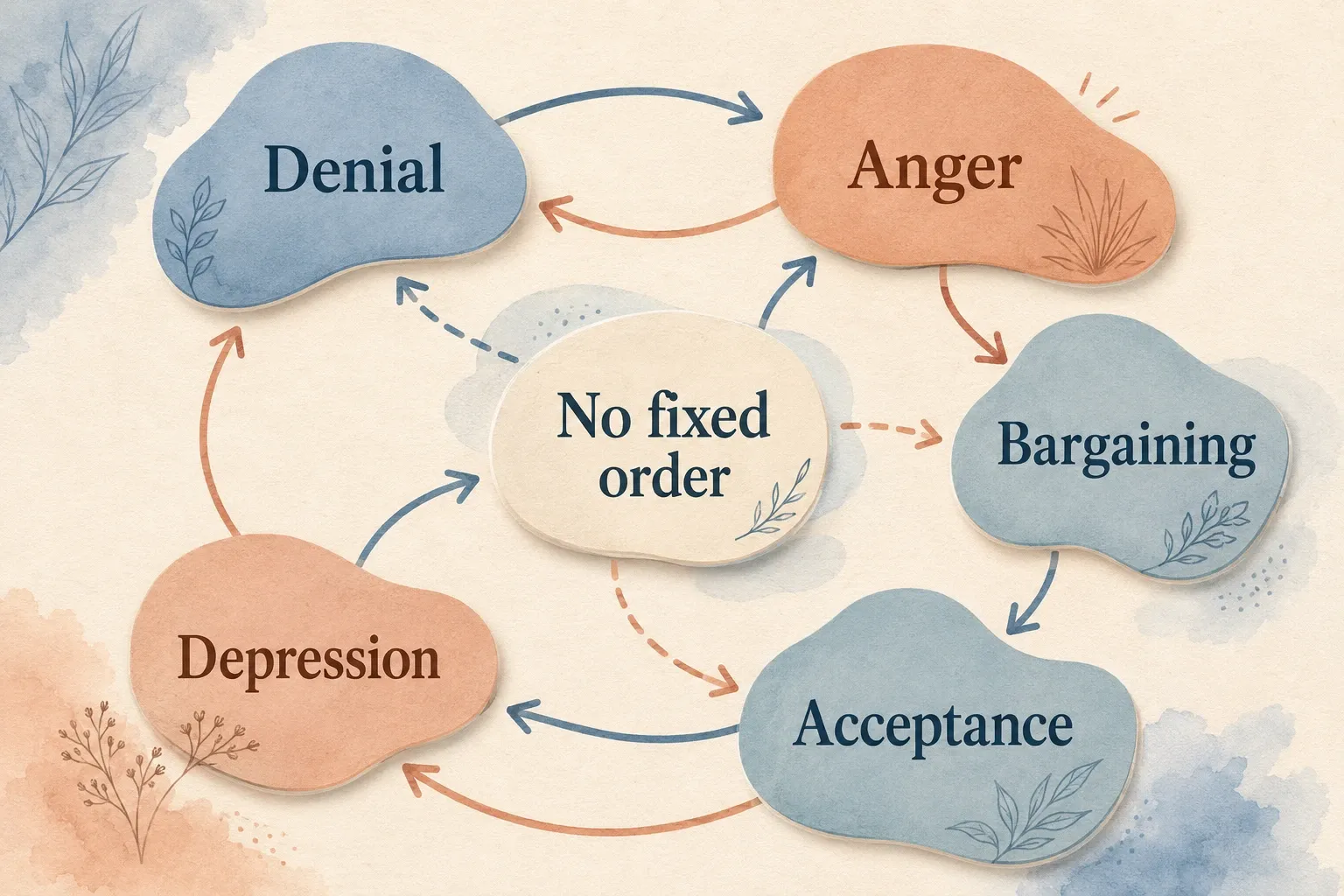
The five stages of grief describe feelings that may happen after a loss:

- Denial: Feeling shocked, numb or unable to believe what happened.
- Anger: Feeling frustrated with yourself, other people or the situation.
- Bargaining: Thinking “if only” or wondering whether the loss could have been prevented.
- Depression: Feeling deep sadness, emptiness or withdrawing from others.
- Acceptance: Beginning to adjust to the loss. This does not mean forgetting the person or no longer feeling sad.
These stages are not a fixed process or checklist [1][7]. You may experience some, all or none of them. They can happen in any order and return at different times. There is no wrong way to move through grief.
What Does Grief Feel Like?
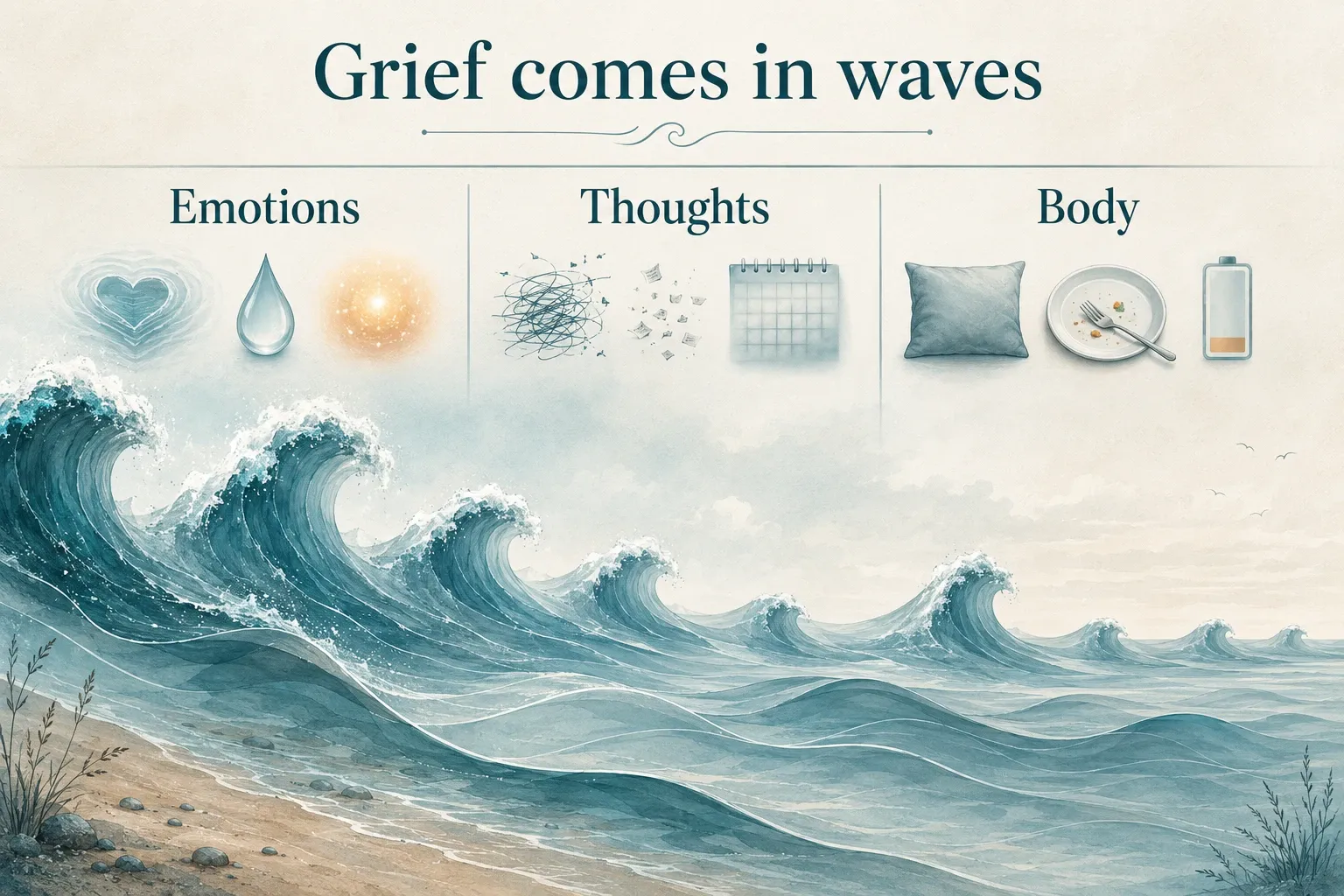
Grief often comes in waves. You may feel steady and then suddenly feel upset because of a song, smell, photograph or special date [1].
Grief can affect both your mind and body:
- Sadness, anger, guilt, longing or relief
- Shock, numbness or confusion
- Difficulty concentrating or remembering things
- Tiredness or low energy
- Sleeping too little or too much
- Eating more or less than usual
- Headaches, body aches or muscle tension
- A tight chest, heavy feeling or unsettled stomach
These reactions often become less intense with time, although grief may return around birthdays, festivals and anniversaries.
Grief can cause physical symptoms, but do not assume every symptom is caused by grief. Speak to a doctor if you have chest pain, breathlessness, an irregular heartbeat, unexplained weight loss or symptoms that are severe or worrying.
There is no correct way to grieve. Asking for support does not mean you are grieving badly; it means you do not want to carry the loss alone.
What Are the Different Types of Grief?
Different losses can lead to different experiences:
- Anticipatory grief: Grief that begins before an expected loss, such as when someone has a serious or terminal illness.
- Prolonged grief: Intense grief that continues for a long time and makes daily life very difficult.
- Disenfranchised grief: Grief that other people may not fully recognise, such as the loss of a pet, a miscarriage or an estranged relationship.
- Grief after a non-death loss: Grief following divorce, migration, job loss, serious illness or the loss of a home or ability.
- Traumatic grief: Grief following a sudden, violent or frightening death. Read more about PTSD and trauma.
How you grieve may also depend on your relationship with the person, whether the loss was expected, your health, available support, financial pressures and your family or cultural beliefs.
Grief vs Depression: What Is the Difference?
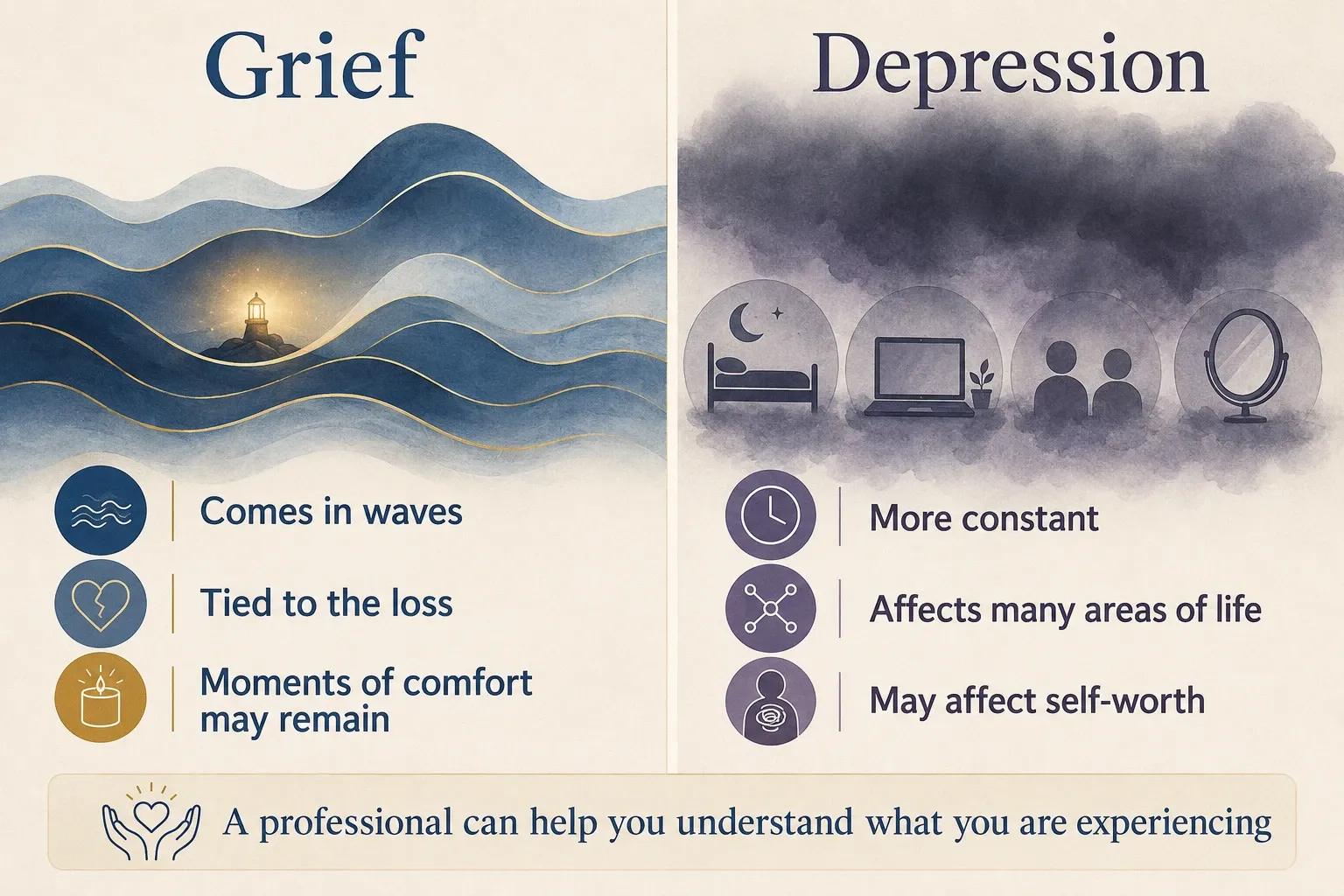
Grief and depression can have similar symptoms, but they are not the same [4].
| Grief | Depression |
|---|---|
| Usually comes in waves | Low mood is present most of the day |
| Feelings are mainly connected to the loss | Low mood affects many areas of life |
| Moments of comfort or enjoyment are still possible | Pleasure and interest are greatly reduced |
| Self-worth usually remains | Worthlessness or strong self-blame may occur |
| Usually becomes easier to carry over time | May continue or worsen without treatment |
Grief and depression can happen together. Seek help if low mood is constant, daily life feels unmanageable or you feel worthless or hopeless. Read more about depression.
When Can Grief Become Prolonged?
Some people experience intense grief that continues for a long time and seriously affects daily life. This is called prolonged grief disorder [2][3].
Possible signs include:
- Intense longing that does not begin to ease
- Difficulty accepting the death
- Avoiding reminders of the loss
- Feeling that life has lost its meaning
- Being unable to return to everyday activities
Grieving for a long time does not automatically mean you have this condition. Only a qualified professional can diagnose prolonged grief disorder.
When Should You Seek Help?
Consider professional support if:
- Grief remains overwhelming for many months
- You cannot manage daily activities
- You are using alcohol or drugs to cope
- You have ongoing depression or anxiety
- You feel that life is not worth living
Counselling, therapy or a support group can give you a safe place to talk. Medication does not treat grief itself, but a doctor may recommend it if depression or anxiety develops.
Learn what to expect in therapy.
If you may harm yourself or cannot stay safe, call 112, go to the nearest hospital or ask someone you trust to stay with you. See our crisis support and helplines.
What Can Help You Cope?
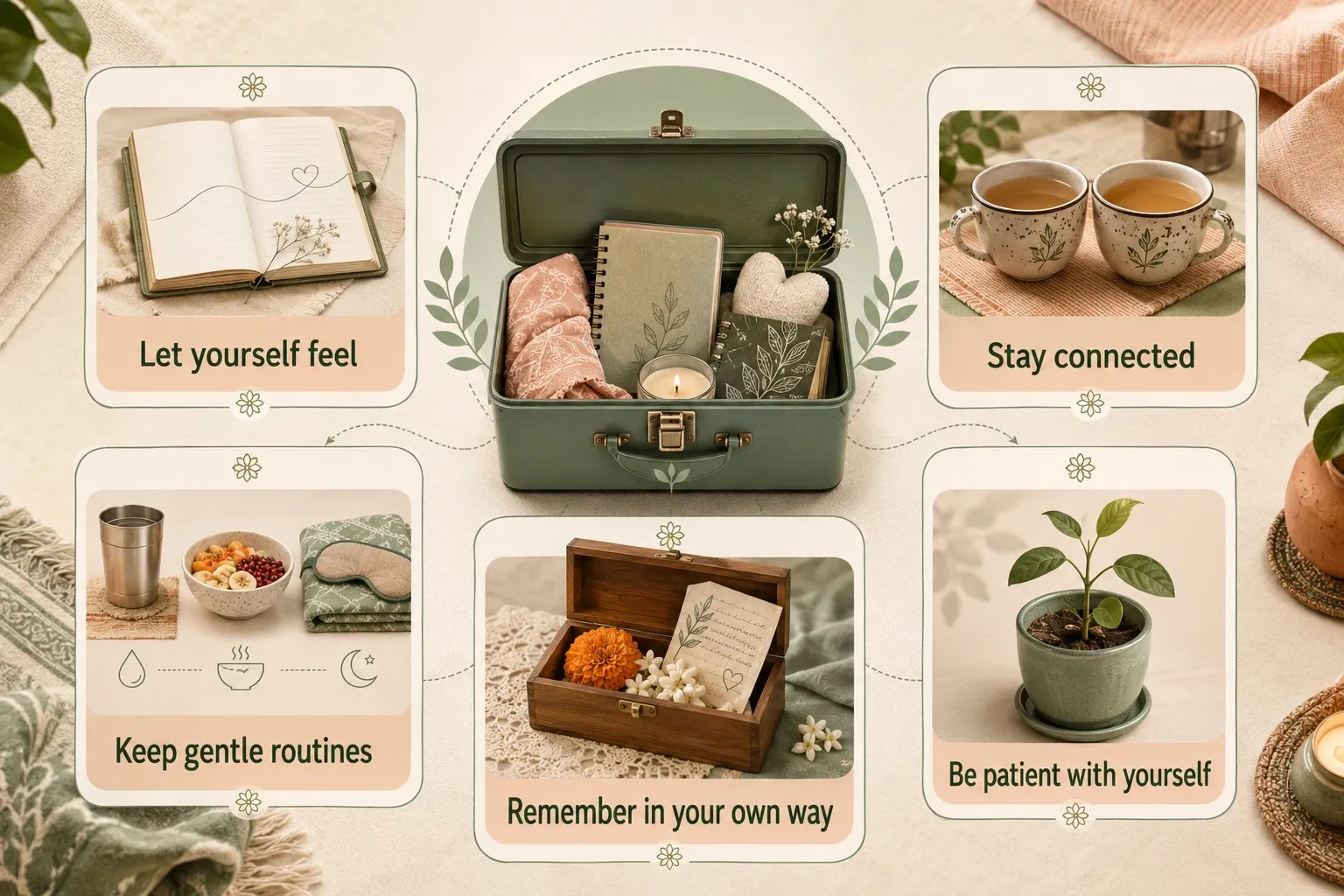
Support from family, friends, a counsellor or a grief-support group may help [5]. You can also:
- Accept practical help from people you trust.
- Maintain simple routines for food, sleep and movement.
- Reduce unnecessary responsibilities where possible.
- Plan ahead for difficult dates and festivals.
- Avoid major decisions during the most painful period.
- Use personal, cultural or religious rituals if they bring comfort.
- Consider counselling or a support group if you feel stuck or alone.
Anger, guilt, relief, numbness and moments of happiness can all be part of grief. These feelings do not mean you cared any less.
How Can You Support Someone Who Is Grieving?
Listen without trying to fix their feelings. Offer specific help, such as bringing food or helping with an errand.
You could say:
- “I’m here if you want to talk.”
- “Would you like company or some space?”
- “Can I help with something this week?”
Avoid telling them to “move on” or “stay strong.” Continue checking in after the first few weeks. Read more about supporting a loved one.
Can Grief Get Better?
Grief may not disappear, but it usually becomes easier to live with. Give yourself time and accept support when you need it. If grief continues to control daily life, a mental health professional can help.

Disclaimer
This blog article discusses mental health and emotional wellbeing for general educational and informational purposes only. It is not a substitute for professional advice, diagnosis, or treatment, and only a qualified mental health professional, such as a psychiatrist, psychologist, or licensed therapist, can diagnose a condition or recommend treatment. If you are struggling, please reach out to a qualified professional or someone you trust; if you are in crisis or may be at risk of harming yourself, use the crisis support resources on this page. For any decisions about your mental health, we encourage you to seek the guidance of a qualified professional.
Most Asked Questions
Can grief cause physical symptoms?
Yes. Grief commonly affects the body, causing tiredness, poor sleep, appetite changes, aches, chest tightness, and trouble concentrating. This is normal. That said, do not assume everything is grief, get symptoms like chest pain, breathlessness, or significant weight loss checked by a doctor.
Is it normal to feel relief after someone dies?
Yes, and it does not mean you did not love them. Relief is common after a long illness or a difficult relationship, and it often sits alongside sadness and guilt. Feeling it does not make you a bad person.
Can grief begin before someone dies?
Yes. This is called anticipatory grief, and it is common when a loved one has a terminal illness. Grieving while someone is still alive does not mean you are giving up on them.
Can grief come back years later?
Yes. Even after grief has eased, waves can return on anniversaries, festivals, or when something reminds you of the person, sometimes for years. This is a normal part of grief, not a setback.
Does everyone go through the five stages of grief?
No. Many people do not experience all five, and they do not happen in a fixed order. The stages are a way of naming common feelings, not a checklist to complete.
What happens in grief counselling?
It usually means talking with a trained professional or a support group about your loss, at your own pace, in a safe space. It is not about "fixing" you, and many people find it helps to feel less alone and more able to cope.
Sources
- 1.
NHS. Get help with grief after bereavement or loss.
- 2.
American Psychiatric Association. Prolonged Grief Disorder
- 3.
Mayo Clinic. Complicated grief: Symptoms and causes.
- 4.
Harvard Health Publishing. Can grief morph into depression?
- 5.
Substance Abuse and Mental Health Services Administration (SAMHSA). Coping with Bereavement and Grief.
- 6.
Tele-MANAS, Ministry of Health and Family Welfare, Government of India (helpline portal, cited at homepage per B9).
- 7.
Maciejewski PK, Zhang B, Block SD, Prigerson HG. An empirical examination of the stage theory of grief. JAMA. 2007;297(7):716–723. doi:10.1001/jama.297.7.716.
- 8.
Bonanno GA. Loss, trauma, and human resilience: have we underestimated the human capacity to thrive after extremely aversive events? American Psychologist. 2004;59(1):20–28. doi:10.1037/0003-066X.59.1.20.
Why Should You Trust Us?
Why Should You Trust Us?
This article was written by Dr. Srishti Rastogi, who has more than 1 years of experience in the healthcare industry.
Allo has the expertise of over 50+ doctors who have treated more than 1.5 lakh patients both online and offline across 30+ clinics.
Our mission is to provide reliable, accurate, and practical health information to help you make informed decisions.
For This Article
- We referenced the American Psychiatric Association's DSM-5-TR and the World Health Organization's ICD-11 criteria for prolonged grief disorder, so the distinction between normal grief and a diagnosable condition reflects actual clinical consensus, not an arbitrary timeline.
- We looked at the original research behind the five stages of grief, including a study that tracked bereaved people over two years, to explain honestly that grief rarely moves through stages in order, rather than repeating the popular but oversimplified version.
- We drew on research into human resilience after loss, which found that most people cope and adapt over time rather than experiencing lasting breakdown, so this guide reflects what typically happens rather than worst-case assumptions.
- We referenced Harvard Health Publishing and Mayo Clinic to draw a clear, practical distinction between grief and depression, so readers can tell the difference between a normal wave of grief and something that may need professional support.
- We consulted SAMHSA's guidance on coping with bereavement for the practical coping steps in this guide, so the advice reflects established approaches rather than generic self-help tips.
- We were careful to represent grief and mourning in the Indian context without flattening it into one description, acknowledging both the strength of communal mourning traditions and the pressure some people feel to suppress grief, particularly men.
- We included NHS guidance on where to find grief support, so readers get a consistent, credible source for both the emotional and practical sides of coping with loss.