Bipolar Disorder: The Highs, the Lows, and What Treatment Looks Like
Written by Dr. Srishti Rastogi

Dr. Srishti Rastogi is a medical writer and healthcare professional dedicated to high-quality patient education and public health awareness. Leveraging her clinical background, she produces deeply researched, evidence-based content for digital health platforms and medical publications. Dr. Srishti’s unique dual perspective as a clinician and communicator allows her to craft content that builds trust and credibility with readers navigating sensitive health topics.
•
August 19, 2026
Our experts continually monitor the health and wellness space, and we update our articles when new information becomes available.
Quick Read
Bipolar disorder is not the same as being moody. It brings episodes of unusually high mood and energy, and episodes of depression, each lasting days or weeks rather than hours. It is often mistaken for ordinary depression for years, which matters because the treatment differs. It is a long-term condition, and with the right treatment most people live full, stable lives.
If you or someone you know is in crisis, help is available right now. You are not alone, and things can get better with the right support.
Everyone’s mood changes. Bipolar disorder is different because mood, energy, sleep and behaviour change together for days or weeks. These episodes can affect work, studies, money, relationships and safety.
Bipolar disorder is often missed because people usually seek help when they feel depressed, not when they have unusually high energy. This guide explains the signs, types, treatment and when to get help.
What Is Bipolar Disorder?
Bipolar disorder is a mental health condition that causes episodes of unusually high or irritable mood and episodes of depression [1].
Ordinary moods may change within a day and usually match what is happening in your life. Bipolar episodes last for days or weeks and cause clear changes in sleep, energy, thinking and behaviour.
Around 37 million people worldwide live with bipolar disorder [1]. It often begins during the late teenage years or twenties but can affect anyone.

What Are the Main Mood Episodes in Bipolar Disorder?
| Mood episode | What it may look like |
|---|---|
| Mania | Very high or irritable mood, fast speech, racing thoughts, little need for sleep and risky decisions |
| Hypomania | Similar changes but less severe; the person may feel unusually confident, active or productive |
| Depression | Low or empty mood, loss of interest, tiredness, hopelessness and difficulty functioning |
| Mixed episode | High energy and depressive feelings at the same time, often with agitation or distress |
Mania can seriously disrupt daily life and may cause someone to lose touch with reality. Hypomania is less severe, so it can be easy to miss.
Needing less sleep is an important warning sign. This is different from insomnia. During a high, someone may sleep for only a few hours and still feel full of energy.

Allo asks
Has anyone close to you ever said you seemed "unusually high," "wired," or "not yourself" during a good period?
What Are the Types of Bipolar Disorder?
- Bipolar I disorder: Involves at least one manic episode. Depressive episodes commonly occur too [1].
- Bipolar II disorder: Involves hypomanic and depressive episodes but no full manic episode. It is not simply a milder form because depression can be severe.
- Cyclothymia: Causes repeated mood changes over a long period, but they do not reach the full level of mania or depression.
Bipolar disorder can sometimes be confused with borderline personality disorder. In borderline personality disorder, mood may change quickly in response to relationships or events. Bipolar episodes usually last longer. Learn more about personality disorders.
Only a qualified mental health professional can make a diagnosis.


Why Is Bipolar Disorder Mistaken for Depression?
People often ask for help during a depressive episode. Hypomania or mania may feel like confidence, productivity or finally “feeling better,” so it may not be mentioned during an assessment.
One large study found an average delay of around six and a half years between first receiving specialist care and being diagnosed with bipolar disorder [3].
Tell your doctor if you have ever experienced:
- Unusually high energy
- Much less need for sleep
- Very fast thoughts or speech
- Unusual confidence or irritability
- Risky spending or impulsive decisions
This information matters because bipolar depression and depression are not treated in the same way. Antidepressants are generally not recommended on their own for bipolar depression because they may trigger mania in some people [2].
Read more about depression.
The pattern I see most often is someone who has been treated for depression for years, sometimes with several different antidepressants, and nothing quite works. When we finally ask about the other side - the weeks of barely sleeping, feeling unstoppable, spending more than usual - that's when the picture changes. It's not a failure of earlier treatment. It's that half the story wasn't in the room yet.
What Causes Bipolar Disorder?
There is no single cause. Genes and biology play an important role, and having a close relative with bipolar disorder can increase the chance of developing it.
Stress, poor sleep and substance use do not necessarily cause bipolar disorder, but they may trigger an episode in someone who already has the condition.
How Is Bipolar Disorder Treated?
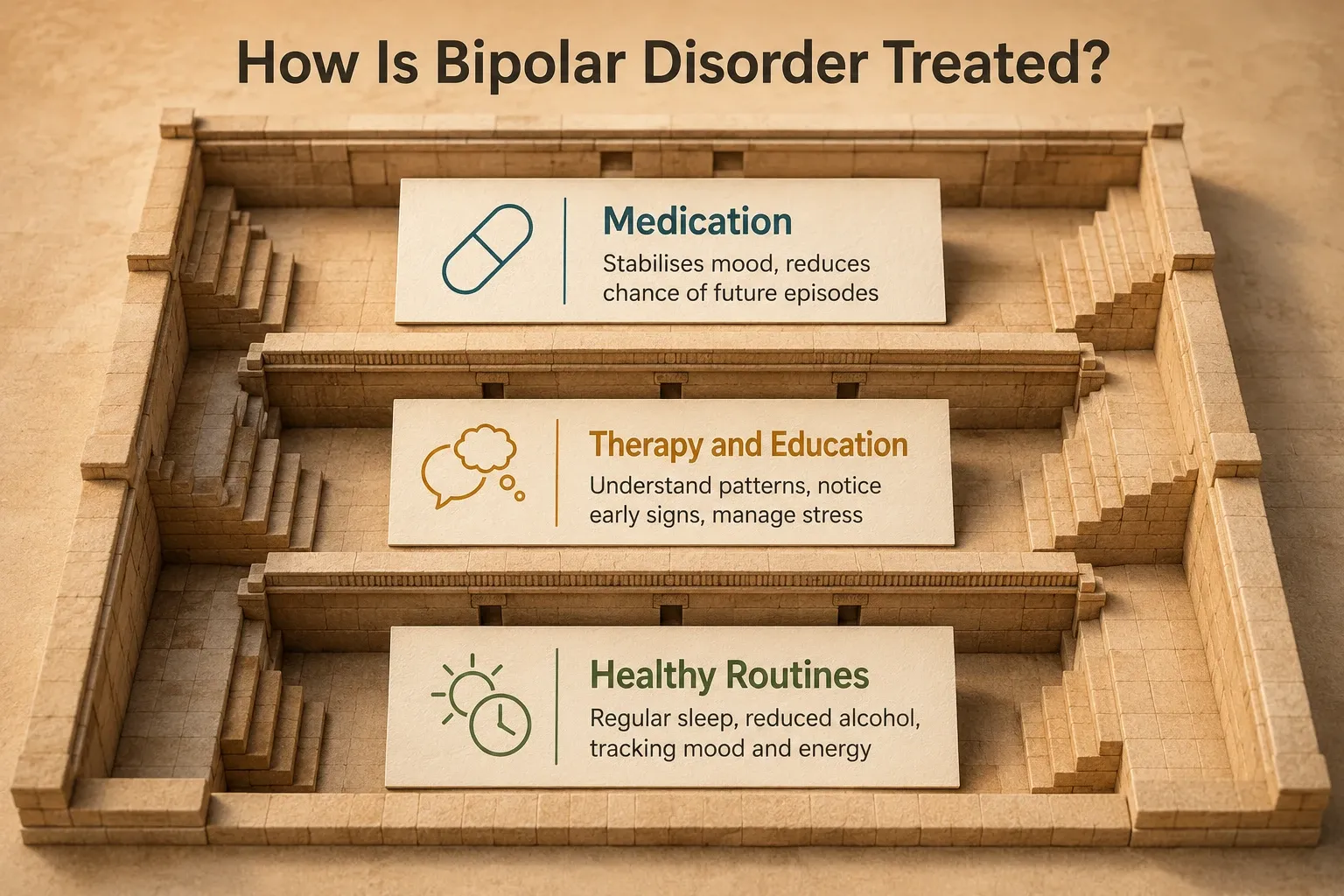
Bipolar disorder is usually managed with medication, psychological support and healthy routines.
Medication
Medication helps treat current episodes and reduce the chance of future episodes. A psychiatrist may prescribe medicines that stabilise mood or treat specific symptoms.
Finding the right medication may take time. Your psychiatrist will consider your symptoms, physical health, side effects and previous response to treatment.
Take medication exactly as prescribed. Do not stop it when you begin to feel well or change the dose yourself. Stopping suddenly may trigger another episode or cause withdrawal effects. Speak to your psychiatrist if you have side effects or want to change your treatment.
Learn more about how psychiatric medication works.
Therapy and Education
Therapy does not replace medication for most people with bipolar disorder, but it can help you:
- Understand your mood patterns
- Notice early warning signs
- Protect your sleep
- Manage stress
- Make a plan for future episodes
- Improve communication with family
Read about what to expect in psychotherapy.
Access to mental health treatment remains limited in India. A national study based on the Mental Health Survey found a treatment gap of around 80% in men and 58% in women with bipolar disorder [5]. Online consultations may make specialist care easier to access in some areas.
How Can You Manage Bipolar Disorder Day to Day?
A few practical steps can support treatment:
- Follow a regular sleep schedule.
- Track changes in mood, sleep and energy.
- Take medication as prescribed.
- Reduce or avoid alcohol and recreational drugs.
- Write down your early warning signs.
- Tell one trusted person what signs to watch for.
- Delay major financial, work or relationship decisions during an episode.
Early signs may include sleeping less, talking faster, spending more or taking on many new plans.
With your permission, someone close to you can help notice these changes. Read our guide to supporting a loved one.
When Should You Seek Help?
Arrange a mental health assessment if:
- Your mood changes in episodes lasting days or weeks
- You have periods of unusually high energy or reduced sleep
- Other people notice that you behave very differently at times
- Depression treatment is not helping as expected
- Mood changes affect work, studies, money or relationships
Some people in India delay care because they worry about judgement, privacy or marriage prospects [4]. These concerns are understandable, but early treatment can reduce the disruption caused by future episodes.
When Is Bipolar Disorder an Emergency?
Seek urgent help if someone:
- Has gone several nights with very little sleep and is becoming increasingly active or impulsive
- Is making dangerous decisions or spending uncontrollably
- Has lost touch with reality
- Has thoughts of suicide or self-harm
- Cannot keep themselves or others safe
Call 112, go to the nearest hospital emergency department or ask a trusted person to stay with them.
Can Bipolar Disorder Get Better?
Yes. Bipolar disorder can be managed with consistent treatment, and many people work, study and maintain fulfilling relationships.
If your mood, energy and sleep change in clear episodes, consider speaking to a qualified mental health professional. You can book a confidential consultation with Allo Health whenever you feel ready.
Disclaimer
This blog article discusses mental health and emotional wellbeing for general educational and informational purposes only. It is not a substitute for professional advice, diagnosis, or treatment, and only a qualified mental health professional, such as a psychiatrist, psychologist, or licensed therapist, can diagnose a condition or recommend treatment. If you are struggling, please reach out to a qualified professional or someone you trust; if you are in crisis or may be at risk of harming yourself, use the crisis support resources on this page. For any decisions about your mental health, we encourage you to seek the guidance of a qualified professional.
Most Asked Questions
Is bipolar disorder just having mood swings?
No. Mood swings move within a day and stay in proportion to what caused them. Bipolar episodes run for days or weeks, arrive without a matching reason, and change sleep, energy, judgement, and how much you can do. Using "bipolar" for ordinary moodiness is part of why people with the real condition wait so long to be taken seriously.
Can bipolar disorder be cured?
It is managed rather than cured, and that is a less discouraging sentence than it sounds. With ongoing treatment, many people go years between episodes and live entirely normal lives. The goal is stability, not a permanent state of being fixed.
Are people with bipolar disorder dangerous?
No. This is a stigma, not a fact, and it does real damage. People living with bipolar disorder are far more likely to be harmed by the condition than to harm anyone else. What a high can genuinely put at risk is money, work, and relationships, which is why early treatment matters.
Can I stop my medicine once I feel well?
Feeling well usually means the treatment is working, not that it is finished. Relapse is much more likely off treatment than on it, and stopping suddenly can be dangerous. If you want to come off, plan it with your psychiatrist.
What should I do if someone I love is having a manic episode?
Stay calm, avoid arguing about whether they are unwell, and focus on safety and sleep. Try to limit access to large sums of money if risky spending has started, and contact their psychiatrist. If they are in danger or losing touch with reality, treat it as urgent and use the helplines at the top of this page.
Sources
- 1.
World Health Organization. Bipolar disorder (fact sheet), updated 8 September 2025.
- 2.
Menon V, Ganesh R, Deep R, et al. Clinical practice guidelines for the management of bipolar disorder: 2025 update. Indian Journal of Psychiatry. 2026;68:8-43.
- 3.
Lublóy Á, Keresztúri JL, Németh A, Mihalicza P. Exploring factors of diagnostic delay for patients with bipolar disorder: a population-based cohort study. BMC Psychiatry. 2020;20:75.
- 4.
Latifian M, Abdi K, Raheb G, Islam SMS, Alikhani R. Stigma in people living with bipolar disorder and their families: a systematic review. International Journal of Bipolar Disorders. 2023;11:9.
- 5.
Bipolar affective disorder in India: a multi-site population-based cross-sectional study (National Mental Health Survey 2015-16). Indian Journal of Psychiatry. 2024.
Why Should You Trust Us?
Why Should You Trust Us?
This article was written by Dr. Srishti Rastogi, who has more than 1 years of experience in the healthcare industry.
Allo has the expertise of over 50+ doctors who have treated more than 1.5 lakh patients both online and offline across 30+ clinics.
Our mission is to provide reliable, accurate, and practical health information to help you make informed decisions.
For This Article
- We referenced the World Health Organization's current fact sheet on bipolar disorder for global prevalence figures and core definitions, so the scale and basic facts in this article reflect the latest available WHO data.
- We cited the 2025 Indian Journal of Psychiatry clinical practice guidelines for bipolar disorder management, so our treatment guidance, including why antidepressants alone aren't recommended for bipolar depression, reflects current Indian clinical standards, not general Western guidance repackaged.
- We referenced a population-based study on diagnostic delay to explain why bipolar disorder is so often mistaken for depression, so this isn't presented as an assumption but as a documented, measured pattern (an average delay of about six and a half years).
- We drew on National Mental Health Survey data specific to bipolar disorder in India to cite the actual treatment gap (around 80% in men, 58% in women), so readers understand this is a widespread, documented access issue, not a personal failing.
- We referenced a systematic review on stigma in bipolar disorder to accurately describe why people in India delay care, including specific concerns like marriage prospects and privacy, grounding that section in actual research rather than general stigma commentary.
- We were careful to distinguish bipolar disorder from conditions it's often confused with, particularly borderline personality disorder, so readers can better recognise which pattern is closer to their own experience.