Dissociative Identity Disorder: What It Really Is, Beyond the Films
Written by Dr. Srishti Rastogi

Dr. Srishti Rastogi is a medical writer and healthcare professional dedicated to high-quality patient education and public health awareness. Leveraging her clinical background, she produces deeply researched, evidence-based content for digital health platforms and medical publications. Dr. Srishti’s unique dual perspective as a clinician and communicator allows her to craft content that builds trust and credibility with readers navigating sensitive health topics.
•
August 23, 2026
Our experts continually monitor the health and wellness space, and we update our articles when new information becomes available.
Quick Read
Dissociative identity disorder is a condition where a person's sense of identity is split into two or more states, with gaps in memory between them. It is not schizophrenia, not a personality disorder, and nothing like the thriller version. It develops out of severe, repeated trauma in childhood, and it is treatable with long-term therapy. Almost everything most people believe about it comes from films.
If you or someone you know is in crisis, help is available right now. You are not alone, and things can get better with the right support.
Have you ever found that you could not remember a conversation, an action or even several hours of your day? Occasional forgetfulness can happen to anyone, but repeated memory gaps, especially with changes in your sense of identity may need professional attention.
This is sometimes linked with dissociative identity disorder (DID). The condition is very different from how films and social media present it. It is mainly connected with memory, identity and severe past trauma, not danger or a “hidden evil personality.”
This article explains what DID feels like, why it may develop, how it is diagnosed and how treatment can help.

Allo asks
Do any of these sound familiar to you or someone you know?
What Is Dissociation?
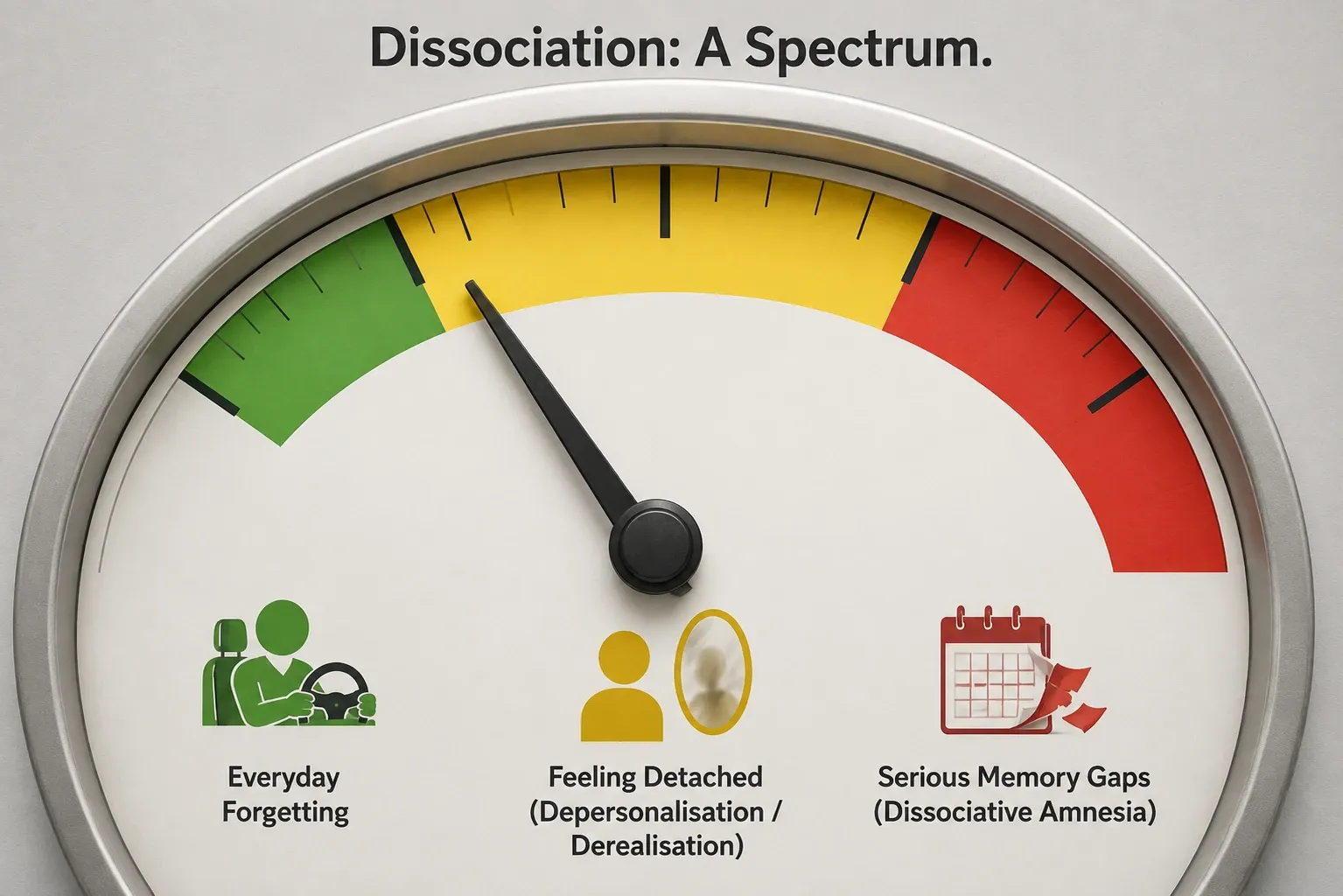
Dissociation means feeling disconnected from your thoughts, memories, body, surroundings or identity.
Mild dissociation can happen to anyone. For example, you might:

- Reach home without clearly remembering the journey
- Read a page without taking in the words
- Lose track of time while daydreaming
This is usually brief and does not cause serious problems.
Stronger dissociation may include:
- Depersonalisation: Feeling detached from yourself or as if you are watching yourself from outside
- Derealisation: Feeling that the world around you is unreal, distant or dream-like
- Dissociative amnesia: Being unable to remember important events or periods of time
Experiencing one of these symptoms does not automatically mean you have DID.

What Is Dissociative Identity Disorder?
Dissociative identity disorder is a condition involving:
- Two or more distinct identity states
- Changes in behaviour, thoughts, feelings or awareness
- Repeated memory gaps that are more serious than normal forgetting
- Distress or difficulty in relationships, work or daily life [1]
A person may forget conversations, appointments or actions. They might find objects they do not remember buying or be told about something they cannot recall doing.
These experiences can have other causes, so only a mental health professional with suitable training can diagnose DID.
This myth causes real harm: that DID is somehow linked to violence or crime. In reality, the people I treat with DID have far more often been harmed themselves; that's usually the origin of the condition. They deserve to be seen as survivors, not as characters from a thriller.
Is DID the Same as Multiple Personalities?
“Multiple personality disorder” is an older name for DID, but it can give the wrong impression.
DID does not mean several complete people are living inside one body. It involves parts of one person’s identity and memories becoming disconnected from each other.
Films often present these identity states as dramatic characters. In real life, the changes may be subtle and difficult for other people to notice.
Is DID the Same as Schizophrenia?
No. DID and schizophrenia are different conditions.
| Dissociative identity disorder | Schizophrenia |
|---|---|
| Mainly affects identity and memory | Mainly affects thinking and the understanding of reality |
| Can involve different identity states | Can involve delusions, hallucinations or disorganised thinking |
| Commonly linked with severe trauma | Develops through several biological and environmental factors |
| Classified as a dissociative disorder | Classified as a psychotic disorder |
Read more about psychosis and schizophrenia.
DID is also not a personality disorder. Personality disorders involve long-term patterns of thinking, feeling and relating to others. Learn more about personality disorders.
What Causes Dissociative Identity Disorder?
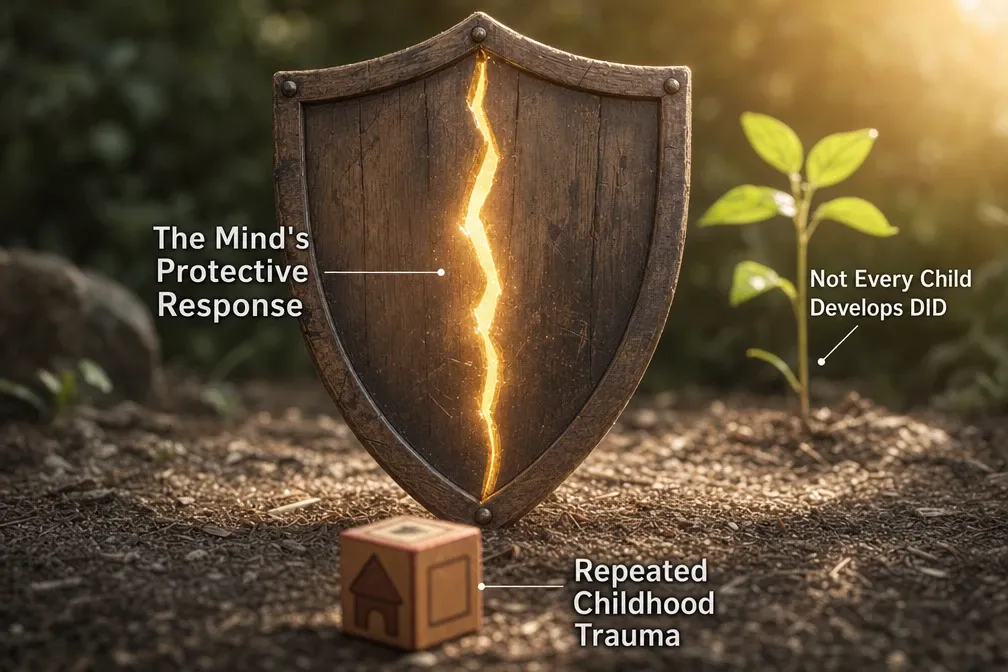
DID is strongly linked with severe and repeated trauma during childhood, particularly when the child could not escape or receive protection [1].
Dissociation may begin as a way to mentally disconnect from an overwhelming experience. If this happens repeatedly while identity and memory are still developing, these parts of experience may remain disconnected.
Not everyone who experiences childhood trauma develops DID. Trauma can affect people in many different ways.
DID is not caused by weakness, attention-seeking or an active imagination. Read more about trauma and PTSD.
What Is It Like to Live With DID?
DID is usually less dramatic than films suggest. Everyday difficulties may include:
- Losing periods of time
- Forgetting conversations or appointments
- Finding belongings you do not remember getting
- Feeling disconnected from your body or identity
- Having difficulty remembering parts of childhood
- Feeling confused about your actions or emotions
- Struggling to maintain work, studies or relationships
Some people also experience depression, anxiety, sleep problems, self-harm or symptoms of PTSD. These concerns may be the reason they first seek professional help.
Are People With DID Dangerous?
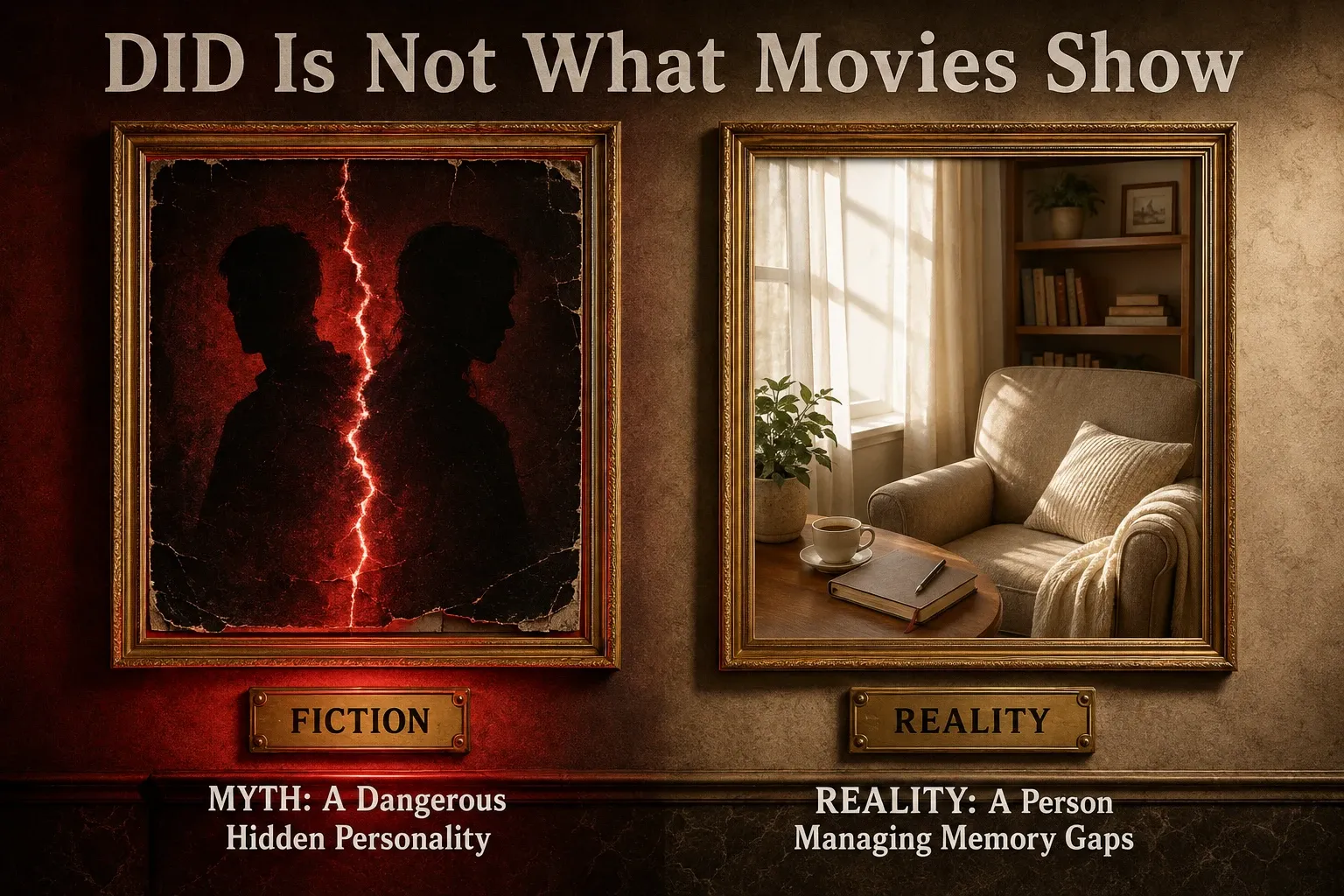
No. Having DID does not make someone violent or dangerous.
Films often connect DID with crime or a frightening “hidden personality.” This is not an accurate picture of the condition. People with DID are more likely to have experienced serious harm themselves.
DID is also not acting or attention-seeking. Symptoms may be difficult to understand, but that does not make them unreal [2].
How Is DID Diagnosed?
There is no blood test or scan for DID. Diagnosis normally takes several appointments with a professional experienced in trauma and dissociation.
The professional may ask about:
- Memory gaps and lost time
- Changes in identity or behaviour
- Feelings of detachment or unreality
- Trauma and mental health history
- Alcohol, drugs or medicines
- Physical or neurological conditions that could cause similar symptoms
DID can be missed because people often seek help for depression, anxiety, sleep problems or trauma symptoms first. A person may also find it difficult to report memory gaps because they do not know what they have forgotten.
Online quizzes and social-media videos cannot diagnose DID.
How Is Dissociative Identity Disorder Treated?
Long-term talking therapy is the main treatment. It generally happens gradually and may include three areas [3]:
Safety and Stability
The first aim is to help the person feel safer and manage daily life. Therapy may focus on:
- Reducing crises and self-harm
- Managing strong emotions
- Using grounding skills
- Building trust with the therapist
- Improving communication between identity states
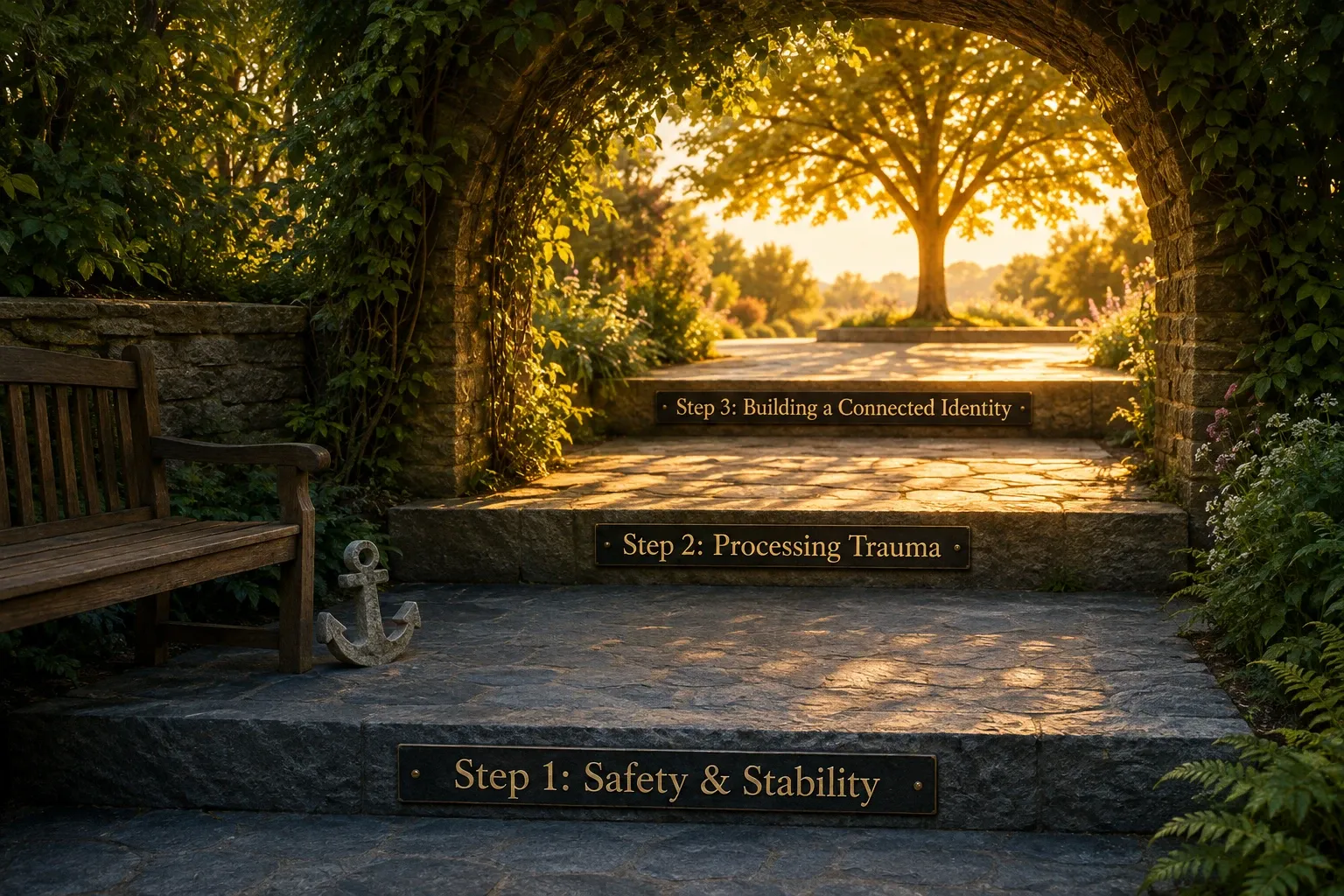
Processing Trauma
Traumatic memories may be explored only when the person is stable enough. The therapist should move at a safe pace so treatment does not become overwhelming.
Building a More Connected Identity
Over time, therapy may help memories and identity states work together more smoothly. The aim is not to erase any part of the person. Some people develop a more unified identity, while others learn to live safely with better cooperation between their identity states.
Medication does not treat DID itself. A doctor may prescribe it for related depression, anxiety or sleep difficulties.
Read about what to expect in psychotherapy.
Are Possession or Trance Experiences Always DID?
No. Religious trance and possession experiences are part of some Indian cultures and are not automatically signs of a mental health condition.
Professional assessment may be helpful when an experience:
- Happens without the person choosing it
- Occurs outside an accepted religious or cultural practice
- Causes fear or distress
- Creates memory gaps
- Affects work, relationships or daily life [4]
A family may use prayer or other faith-based support while also consulting a qualified mental health professional. Medical care and religious support do not always have to replace each other.
When Should You Seek Help?
Consider speaking to a mental health professional if you:
- Regularly lose time you cannot explain
- Cannot remember important conversations or actions
- Often feel detached from yourself or your surroundings
- Experience unexplained changes in your identity or behaviour
- Have symptoms that affect work, studies or relationships
- Use alcohol or drugs to cope
- Experience self-harm or suicidal thoughts
You do not need to be certain that you have DID before requesting an assessment.
When Is Urgent Help Needed?
Get urgent help if you may harm yourself, cannot stay safe or feel unable to manage what is happening.
- Call 112, India’s emergency number.
- Go to the nearest hospital emergency department.
- Ask someone you trust to stay with you.
- Visit our crisis support and helplines page.
Can DID Get Better?
Yes. Recovery can take time, but specialist therapy can improve safety, memory, emotional control and daily functioning.
If dissociation or unexplained memory gaps are affecting your life, consider speaking confidentially with a qualified mental health professional. If you are worried about someone else, read our guide to supporting a loved one.
Disclaimer
This blog article discusses mental health and emotional wellbeing for general educational and informational purposes only. It is not a substitute for professional advice, diagnosis, or treatment, and only a qualified mental health professional, such as a psychiatrist, psychologist, or licensed therapist, can diagnose a condition or recommend treatment. If you are struggling, please reach out to a qualified professional or someone you trust; if you are in crisis or may be at risk of harming yourself, use the crisis support resources on this page. For any decisions about your mental health, we encourage you to seek the guidance of a qualified professional.
Most Asked Questions
Is DID the same as schizophrenia?
No, and they are not related. Schizophrenia involves losing contact with what is real, through delusions or hallucinations. DID involves a sense of identity that has split into parts, with memory gaps between them. The confusion comes entirely from "split personality" being used loosely for both.
Are alters separate people?
No, though they can feel that way from the inside and be described that way. They are parts of one person that never merged into a single continuous self. Treatment does not try to remove them; it works towards them functioning together.
Can DID be cured?
"Cured" is not the word clinicians use, and treatment is measured in years rather than sessions. What is realistic is a great deal better: fewer crises, fewer memory gaps, and a steadier sense of who you are. Many people reach a point where it no longer runs their life.
Can you have DID without knowing?
Yes, and this is common. The memory gaps make the condition difficult to see from the inside, and most people arrive at a clinic asking about depression, anxiety, or trauma instead. It is frequently identified years after someone first sought help.
A lot of what I have seen about DID is on social media. Is that accurate?
Some of it is, some of it is not, and it is very hard to tell apart from outside. Recognising yourself in an online video is not a diagnosis, and building an identity around one is its own risk. If it resonates, that is worth taking to a professional rather than settling alone.
Sources
- 1.
American Psychiatric Association. What Are Dissociative Disorders?
- 2.
Brand BL, Sar V, Stavropoulos P, et al. Separating fact from fiction: an empirical examination of six myths about dissociative identity disorder. Harvard Review of Psychiatry. 2016;24(4):257-270.
- 3.
International Society for the Study of Trauma and Dissociation. Guidelines for treating dissociative identity disorder in adults, third revision. Journal of Trauma & Dissociation. 2011;12:115-187.
- 4.
During EH, Elahi FM, Taieb O, Moro MR, Baubet T. A critical review of dissociative trance and possession disorders: etiological, diagnostic, therapeutic, and nosological issues. Canadian Journal of Psychiatry. 2011;56(4):235-242.
Why Should You Trust Us?
Why Should You Trust Us?
This article was written by Dr. Srishti Rastogi, who has more than 1 years of experience in the healthcare industry.
Allo has the expertise of over 50+ doctors who have treated more than 1.5 lakh patients both online and offline across 30+ clinics.
Our mission is to provide reliable, accurate, and practical health information to help you make informed decisions.
For This Article
- We were direct about the difference between DID and both schizophrenia and personality disorders, including a clear comparison of what each condition actually affects, so readers get an accurate distinction instead of the conflation films and social media rely on.
- We drew on the established clinical link between DID and severe, repeated childhood trauma, so the explanation of why it develops reflects what's actually understood rather than the "hidden evil personality" framing popular culture uses.
- We addressed religious trance and possession experiences within Indian cultural context directly, distinguishing them from DID rather than pathologizing practices that are a normal part of many people's faith.
- We were honest that DID cannot be diagnosed through an online quiz or a single conversation, and that it typically takes several appointments with a professional experienced in trauma and dissociation, so readers aren't given a false sense of how diagnosis actually works.
- We laid out the three-part structure of long-term treatment (safety and stability, processing trauma, building a more connected identity) as it is actually practiced, rather than suggesting a quick fix exists.
- We were clear that medication does not treat DID itself, only conditions that may occur alongside it, so the article doesn't overstate what medication can do here.