Health Anxiety and Hypochondria: Symptoms, Signs and Treatment
Written by Dr. Srishti Rastogi

Dr. Srishti Rastogi is a medical writer and healthcare professional dedicated to high-quality patient education and public health awareness. Leveraging her clinical background, she produces deeply researched, evidence-based content for digital health platforms and medical publications. Dr. Srishti’s unique dual perspective as a clinician and communicator allows her to craft content that builds trust and credibility with readers navigating sensitive health topics.
•
October 12, 2026
Our experts continually monitor the health and wellness space, and we update our articles when new information becomes available.
Quick Read
Health anxiety is persistent, distressing worry about having or developing a serious illness, strong enough to shape your days. The sensations you notice are real. What keeps the worry going is not a missing diagnosis but the checking and the reassurance-seeking, because relief from those never lasts. It responds very well to treatment, and a real symptom still deserves a real medical opinion.
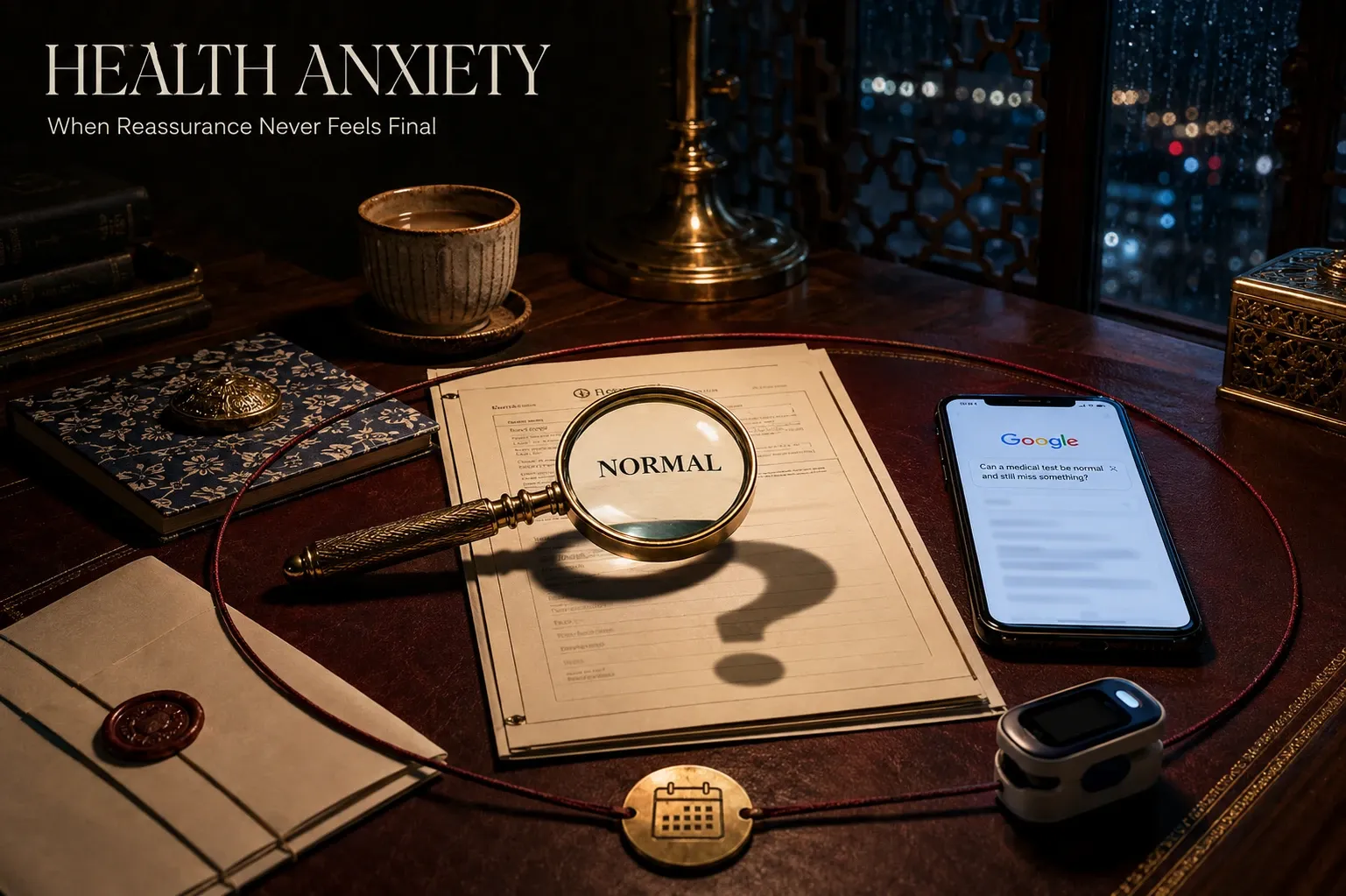
Your test report comes back normal. You feel better for a day or two. Then you notice that the pain is still there and think, “What if the test missed something?”
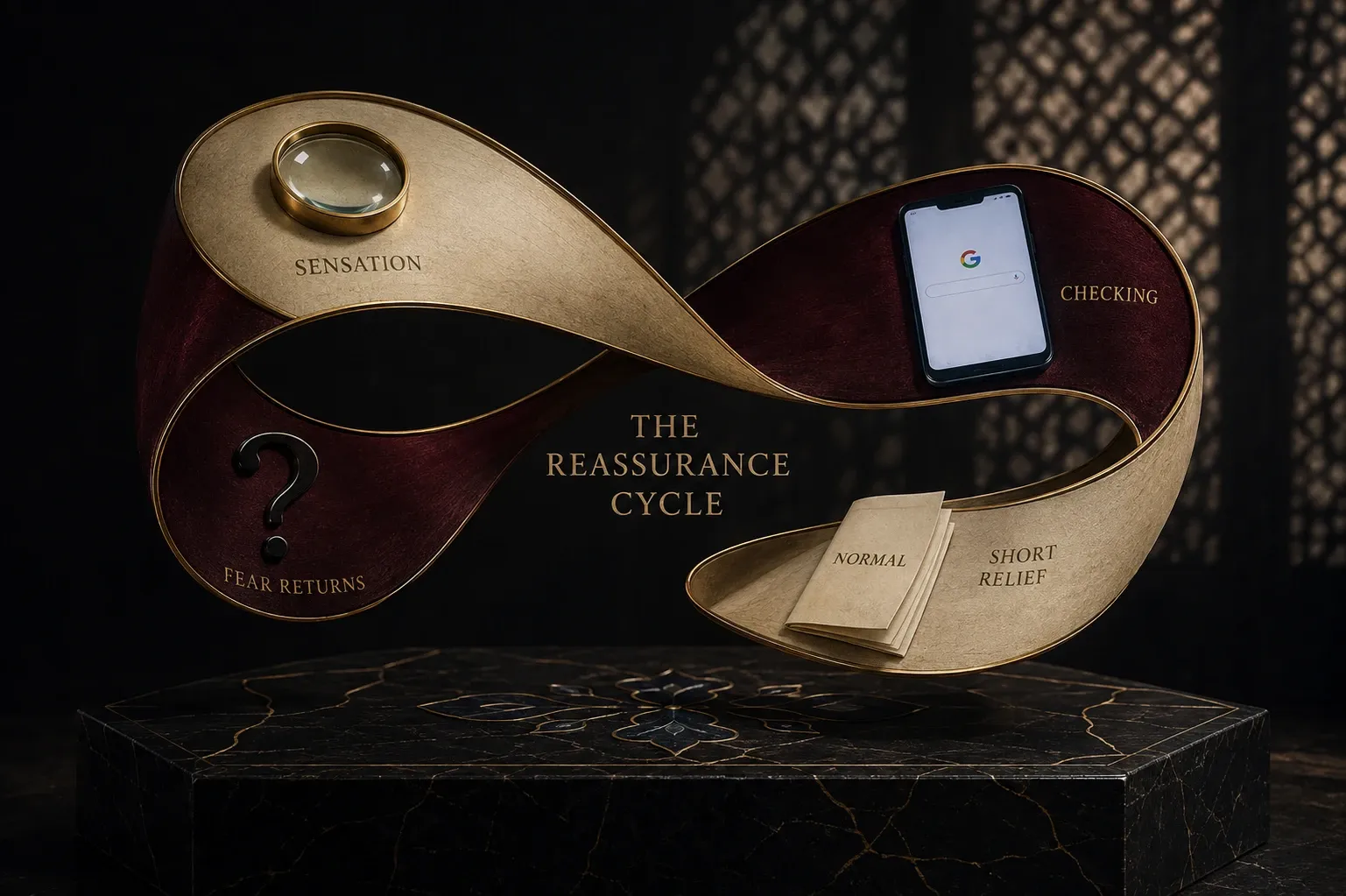
This repeating cycle is one of the main signs of health anxiety.
What Is Health Anxiety?
Health anxiety means spending a lot of time worrying that you have or may develop a serious illness. The worry is strong enough to cause distress or affect your daily life [1].
Clinicians may diagnose illness anxiety disorder when this pattern continues for at least six months. People with this condition usually have no physical symptoms or only mild ones. The main fear is about what a sensation could mean [2].
“Hypochondria” is the older term that many people still search for. “Illness anxiety disorder” is the term now used by clinicians. Calling someone a “hypochondriac” is not helpful. It can sound like an accusation and may stop the person from talking honestly about their fear.


Allo asks
What usually happens after a doctor says your reports are normal?
Can Your Physical Symptoms Still Be Real?
Yes. Having health anxiety does not mean that every sensation is imaginary.
A racing heart, headache, pain or lump can be a real physical experience. Health anxiety mainly changes how you understand the sensation and how much danger you attach to it.
Having health anxiety also does not protect you from developing a genuine illness. A new, persistent or changing symptom should still be discussed with a doctor. Severe or urgent symptoms need prompt medical care.
The concern may be health anxiety when repeated examinations find no serious cause, but the fear continues or quickly moves to another illness.

Why Does Reassurance Not Help for Long?
Checking your body, searching symptoms online or asking someone for reassurance may reduce anxiety for a short time. Because that relief feels good, you repeat the behaviour whenever the fear returns. Gradually, you may need to check more often or ask more people before you feel safe.
Even a normal test may not settle the fear. You may start thinking:
“What if the test was done too early?”
“What if the doctor missed something?”
“What if I need a different test?”
No medical test can promise that you will never become ill. This means a search for complete certainty cannot truly end. Treatment does not try to give you perfect certainty. It helps you manage a normal amount of uncertainty without repeatedly checking or seeking reassurance.
Can Health Anxiety Make You Avoid Doctors?
Yes. Health anxiety does not always lead to repeated appointments and medical tests.
In the care-seeking type, a person may visit several doctors, request repeated tests or seek many medical opinions [2].
In the care-avoidant type, a person may stay away from doctors because they are frightened of receiving bad news. They may delay tests, ignore symptoms or avoid routine screening [2].
Both patterns can come from the same fear.
Avoiding medical care may delay the diagnosis of a condition that needs treatment. If fear is stopping you from attending an appointment or test, tell the doctor when you book it.
What Are the Signs of Health Anxiety?
Health anxiety often appears through checking, searching, seeking reassurance or avoiding health information.
You may repeatedly examine a mole, take your pulse, press the same painful area or check your body for lumps. You may search symptoms online, compare your experience with strangers’ stories or keep reading until you find a serious illness that seems to fit.
You might repeatedly ask family members whether you look unwell or return to a doctor with the same fear after receiving normal results.
Some people do the opposite. They avoid health programmes, hospitals, medical tests or conversations about illness.
Most people do some of these things occasionally. It becomes a concern when the behaviour takes up a lot of time, causes distress or affects daily life.

Is It Health Anxiety, OCD or Ordinary Worry?
Ordinary health worry usually starts for a clear reason and settles after the concern has been properly checked. Health anxiety continues even after medical reassurance.
Obsessive-compulsive disorder involves unwanted thoughts and repeated behaviours or mental rituals. These can focus on contamination, harm, order, religion or other themes. Health anxiety stays mainly focused on illness. However, the two conditions can overlap.
Generalised anxiety disorder causes worry across several areas, including money, work, family and health. Health anxiety repeatedly returns to illness.
In somatic symptom disorder, physical symptoms are usually more strongly present and distressing. In illness anxiety disorder, symptoms are absent or mild, but the fear of what they could mean is intense [1].
Only a qualified professional can identify which condition fits. It is also possible to have more than one condition.
Searching symptoms online can feel helpful at first, but it often gives health anxiety more reasons to continue.
Why “Dr Google” Hits Harder in India
Searching one symptom online can quickly lead you from a common cause to a rare or serious illness. Instead of making you feel better, each search may give you something new to worry about. And when repeated health searches increase anxiety, this pattern is sometimes called cyberchondria.
A study of 205 IT professionals in Chennai placed about 56% in a higher-scoring cyberchondria group [4]. Excessive searching was the strongest feature, followed by reassurance-seeking. Easy access to medical tests can also keep the cycle going. Many diagnostic centres in India advertise full-body check-ups and allow people to book tests without first speaking to a doctor. This can turn a late-night worry into a test booking within minutes.
But this does not mean you should avoid a test recommended by your doctor. It means testing decisions are best made with one doctor who knows your medical history, rather than through repeated online searches or self-booked tests.

What Is the Best Treatment for Health Anxiety?
Cognitive Behavioural Therapy
Cognitive behavioural therapy, or CBT, is a main treatment for health anxiety [2].
A review of 14 randomised trials found that CBT produced a large reduction in health anxiety compared with usual care, waiting lists, medication and other psychological therapies. The benefits were still present after six and twelve months [3].
CBT helps you understand what triggers the fear and how you interpret physical sensations. It also helps you gradually reduce checking, online searching and reassurance-seeking. The aim is not to ignore every symptom. It is to respond in a balanced way instead of treating every sensation as an emergency.
Read what to expect in psychotherapy to understand how therapy sessions work.
Medication
A doctor may prescribe certain antidepressants that are also used for anxiety conditions [2]. Medication may be offered alone or with therapy, depending on your symptoms and preferences. Only a qualified doctor should prescribe and monitor medication. Do not start, stop or change it yourself.
Read more about psychiatric medications.

How Can Seeing One Regular Doctor Help?
Seeing one doctor who knows your medical history can reduce repeated testing and visits to different clinics. You and your doctor can agree on which symptoms need testing, which changes need another appointment, and how often routine follow-ups are required.
However, this does not mean that new symptoms will be ignored. It means medical decisions are made calmly by someone who understands the full picture, rather than being made again whenever anxiety rises.
When Should You Get Help?
Consider speaking to a mental health professional if health worries take up hours of your day, repeatedly send you online, lead to unnecessary tests or strain your relationships. You should also seek support if fear is making you avoid doctors, blood tests, scans or routine screening.
If someone close to you has health anxiety, repeatedly reassuring them may calm the fear only briefly. Read how to support a loved one without becoming part of the reassurance cycle.
If any of this sounds familiar, you can book a confidential consultation with Allo Health to understand what is happening and what treatment may help.
Disclaimer
This blog article discusses mental health and emotional wellbeing for general educational and informational purposes only. It is not a substitute for professional advice, diagnosis, or treatment, and only a qualified mental health professional, such as a psychiatrist, psychologist, or licensed therapist, can diagnose a condition or recommend treatment. If you are struggling, please reach out to a qualified professional or someone you trust; if you are in crisis or may be at risk of harming yourself, use the crisis support resources on this page. For any decisions about your mental health, we encourage you to seek the guidance of a qualified professional.
Most Asked Questions
Am I a hypochondriac?
That is not a question a page can answer, and it is not a word worth applying to yourself. What is answerable is whether worry about illness is taking up significant time, causing distress, and changing what you do. If it is, that is worth an assessment, whatever anyone has called it.
Does this mean I'm imagining my symptoms?
No. The sensations are real, and they are the same sensations everyone has. The difference is in what happens next: whether a twinge stays a twinge, or becomes a question that needs answering today. Health anxiety is a problem of interpretation and response, not of invention.
Should I stop googling my symptoms?
"Stop" rarely works, because the urge is strongest exactly when you have decided to stop. It is more realistic to change the terms: agree with yourself or your clinician what would actually warrant a search, and treat the rest as the loop asking to be fed. Bringing the searching up in treatment works better than trying to win against it alone.
My family says I'm attention-seeking. Are they right?
No, and this is one of the most damaging misreadings of the condition. The distress is genuine, and people with health anxiety generally want reassurance rather than attention. The behaviour is a response to fear, not a performance, and being told otherwise is a common reason people stop mentioning it.
My family says I'm attention-seeking. Are they right?
No, and this is one of the most damaging misreadings of the condition. The distress is genuine, and people with health anxiety generally want reassurance rather than attention. The behaviour is a response to fear, not a performance, and being told otherwise is a common reason people stop mentioning it.
Sources
- 1.
American Psychiatric Association. What Is Somatic Symptom Disorder? (includes illness anxiety disorder).
- 2.
Kaur J, Alsheikh AM, et al. Illness Anxiety Disorder. StatPearls. NCBI Bookshelf.
- 3.
Cooper K, Gregory JD, Walker I, Lambe S, Salkovskis PM. Cognitive Behaviour Therapy for Health Anxiety: A Systematic Review and Meta-Analysis. Behavioural and Cognitive Psychotherapy. 2017;45(2):110-123. DOI 10.1017/S1352465816000527.
- 4.
Makarla S, Gopichandran V, Tondare D. Prevalence and correlates of cyberchondria among professionals working in the information technology sector in Chennai, India: a cross-sectional study. Journal of Postgraduate Medicine. 2019;65(2):87-92.
Why Should You Trust Us?
Why Should You Trust Us?
This article was written by Dr. Srishti Rastogi, who has more than 1 years of experience in the healthcare industry.
Allo has the expertise of over 50+ doctors who have treated more than 1.5 lakh patients both online and offline across 30+ clinics.
Our mission is to provide reliable, accurate, and practical health information to help you make informed decisions.
For This Article
- We used information from the American Psychiatric Association and NCBI Bookshelf to explain illness anxiety disorder accurately.
- We reviewed a systematic review and meta-analysis of 14 studies on CBT for health anxiety.
- We included findings from an Indian study of 205 IT professionals to make the discussion about online symptom searching more locally relevant.
- We clearly explained the limits of the Indian study instead of applying its findings to everyone.
- We separated health anxiety from genuine medical symptoms and recommended medical assessment for new, persistent or changing symptoms.