Dr. Pranitha Bangera is a gold-medalist dentist with a strong foundation in clinical training and patient care. Alongside her medical background, she has earned accolades in literature, reflecting her lifelong passion for storytelling. She now combines these skills to create engaging, research-driven healthcare content that empowers readers with reliable patient education.
Her writing interests cover sexual health, mental health, and the latest healthcare innovations, where she simplifies complex medical concepts for a broader audience. Beyond writing, she has contributed to healthcare startups in roles such as community manager, creative director, and medical outreach coordinator, gaining valuable insights into healthcare marketing and patient engagement.
A winner of several hackathons, including the Hult Prize on-campus round in 2024, Dr. Bangera continues to explore the intersection of medicine, digital health, and communication. Her goal is to make accurate healthcare information accessible, trustworthy, and easy to understand for people everywhere.
Our experts continually monitor the health and wellness space, and we update our articles when new information became available.
Updated on 19th December 2025
Article was updated as part of our commitment to diversity, equity, and inclusion.
Share this
INErectile Dysfunction
Brance Chatbot
Quick Read
Erectile dysfunction is a common and treatable condition with multiple therapy options available. Treatment may include psychological support such as sex therapy, physical approaches like pelvic floor exercises and vacuum devices, medical treatments including oral medications and injections, and advanced options such as shockwave therapy or surgery in severe cases. The most effective erectile dysfunction therapy depends on the underlying cause, severity, age, and overall health. A personalized, step-by-step approach that combines medical care with lifestyle and mental health support often delivers the best long-term results.
Read more
Erectile dysfunction is a common condition that affects men across different age groups and health backgrounds. Erectile dysfunction therapy focuses on identifying and treating the physical, psychological, and lifestyle factors that interfere with normal erections.
Erectile dysfunction is usually linked to changes in blood flow, blood vessel health, hormone levels, mental health, or underlying medical conditions such as high blood pressure, heart disease, or diabetes. With the right combination of therapies, erectile dysfunction can be managed effectively.
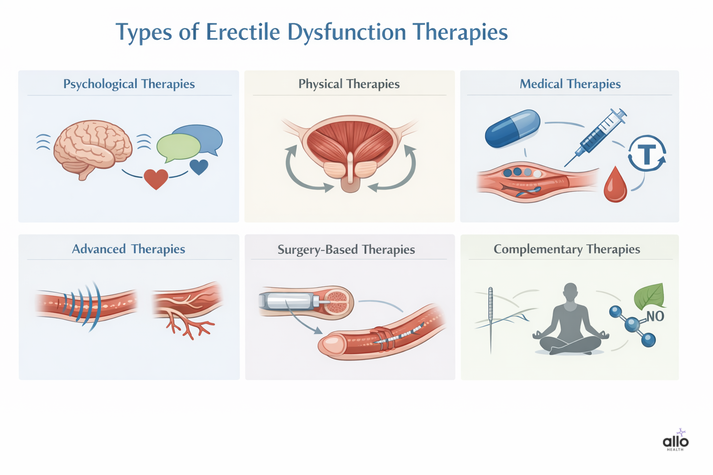
In this article, we will look at the full range of erectile dysfunction therapy options, including sex therapy for erectile dysfunction, physical and mechanical treatments, medical and clinical therapies, advanced approaches, and surgical options. We will also learn how each therapy works, who it is best suited for, and how to choose the most appropriate treatment based on individual needs and health factors.
Allo asks
Which erectile dysfunction therapy would you be most open to trying first?
Lifestyle changes
13.3%
Sex therapy
6.7%
Oral medications
26.7%
Devices like a vacuum pump
13.3%
I’d rather talk to a doctor first
6.7%
What Is Erectile Dysfunction Therapy?
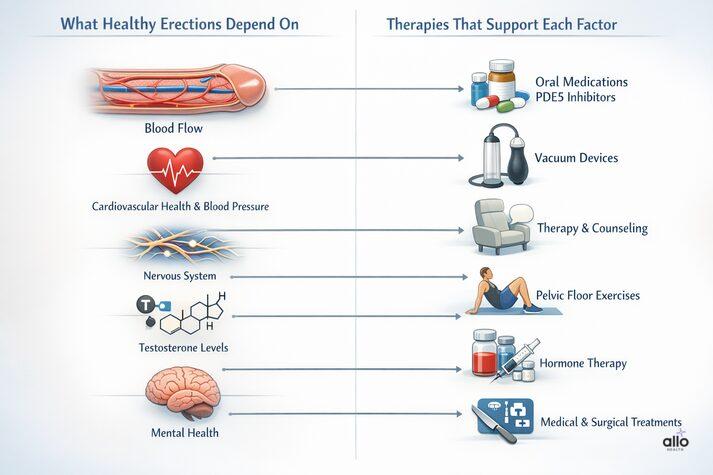
Erectile dysfunction therapy refers to the range of medical, psychological, physical, and lifestyle-based approaches used to treat erectile dysfunction. Because erections depend on healthy blood flow, functioning blood vessels, proper nerve signals, balanced hormones, and good mental health, treatment often focuses on more than just one of these factors.
Modern ED treatment aims not only to restore erections but also to improve overall sexual health, heart health, and quality of life. Depending on the cause, therapy may involve oral medications, mechanical devices, counseling, or surgical options.
Sex therapy focuses on addressing emotional blocks, performance pressure, and sexual confidence. It helps individuals and couples understand sexual responses, improve communication, and reduce fear linked to erection problems.[2]
Cognitive Behavioral Therapy (CBT)
CBT is an evidence-based method of psychological therapy that helps identify and reframe negative thought patterns related to sex, performance anxiety, and self-esteem. It is particularly helpful when erectile dysfunction is linked to stress, depression, or mental health concerns.[3]
Couples therapy involves both partners and addresses relationship stress, communication issues, and emotional distance that may worsen erectile dysfunction. Partner involvement often improves treatment outcomes and long-term satisfaction.[4]
Anxiety and Performance Therapy
This therapy focuses specifically on performance anxiety, a common cause of mild erectile dysfunction in younger individuals. Techniques may include relaxation training, mindfulness, and breathing exercises.[5]
2. Physical Therapies
These therapies aim to improve blood flow and muscle support needed for erections without medication.
Pelvic Floor Exercises (Kegel routine)
Pelvic floor exercises strengthen muscles that support erections by improving blood flow in the penis. Regular Kegel exercises can help improve erection firmness and ejaculatory control.[6]
Vacuum Erection Device (VED) / Penis Pump
A Vacuum Erection Device uses negative pressure to draw blood into the penis. Once an erection is achieved, a tension ring helps maintain it. Vacuum erection devices are effective treatments for many men, including those with high blood pressure, cardiovascular disease, or diabetes.[7]
Penile Traction Therapy
Penile traction devices apply gentle stretching forces to penile tissue. While more commonly used for penile curvature(Peyronie’s disease), they may help improve blood circulation and penile tissue health in selected cases.[8]
3. Medical Therapies
These are commonly prescribed ED treatments supported by strong clinical evidence.
Oral Medications (PDE5 inhibitors)
PDE5 inhibitors like Viagra, Cialis are oral medications that improve erections by increasing blood flow through the blood vessels of the penis. These prescription drugs include sildenafil, tadalafil, and other related oral medicines. They are not suitable for people taking nitrate drugs or those with certain heart disease conditions.[9]
Penile Injections
Penile injections (intracavernosal injections) deliver ED medication directly into the erectile tissue of the penis( corpus cavernosum) to trigger an erection. This method is highly effective, especially when oral medications fail.[10]
Intraurethral Suppositories
Intraurethral therapy (MUSE) involves placing a urethral suppository into the urinary opening to improve blood flow. It is less invasive than injections but may be less effective.[11]
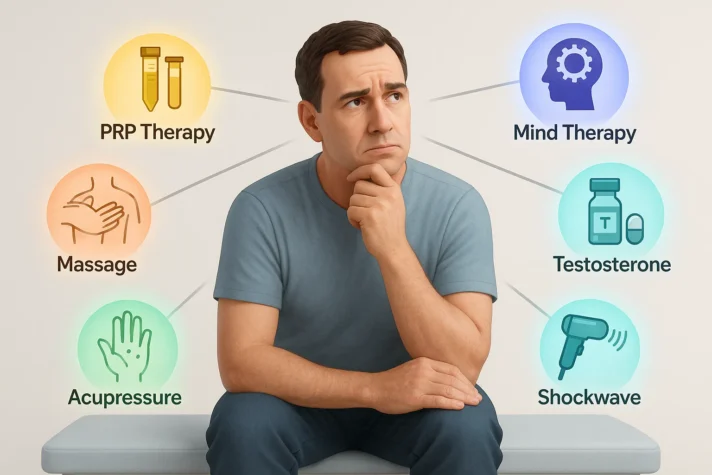
Testosterone Therapy
Testosterone replacement therapy is used when low testosterone levels contribute to erectile dysfunction and reduced sex drive. It is only recommended after proper laboratory evaluations confirm a deficiency.[12]
PRP Therapy (Platelet-Rich Plasma)
Platelet-rich plasma therapy uses proteins called growth factors from a patient’s own blood to support penile tissue repair. This is used when the ED occurs because of damage to the erectile tissues and blood vessels. While promising, PRP remains an emerging ED treatment.[13]
Stem Cell Therapy
Stem cell therapy is meant to help the body heal itself by repairing damaged tissue in the penis. The goal is to improve blood flow and support healthier erections over time, rather than providing a short-term fix. However, this treatment is still in the research stage. Doctors do not yet have enough proof that it is safe, effective, or reliable for everyday use. Because of this, stem cell therapy is not approved by the Food and Drug Administration and is not considered a standard treatment for erectile dysfunction.[14]
4. Advanced Therapies
These therapies focus on restoring natural erectile function rather than providing short-term support.
Shockwave Therapy (Li-ESWT)
Low-intensity shockwave therapy uses sound waves to stimulate new blood vessel formation and improve blood flow. It may benefit men with vascular erectile dysfunction or mild erectile dysfunction.[15]
5. Surgery-Based Erectile Dysfunction Therapy
Surgical options are reserved for severe or treatment-resistant cases.
Penile Implant Surgery
Penile implants, also called penile prosthesis, are surgically placed devices that allow erections on demand. Penile implants offer high satisfaction rates but involve a surgical procedure and heavy cost considerations.[16]
Vascular Surgery
Vascular surgery aims to repair damaged blood vessels in young men with specific blood vessel injuries. It is rarely recommended and limited to select cases.[17]
6. Complementary Therapies
These approaches may support ED treatment but should not replace evidence-based care.
Acupuncture Therapy
In acupuncture therapy, very thin needles are placed at specific points on the body and left in place for about 20–30 minutes. These points are chosen to stimulate nerves, improve blood flow, and calm the nervous system. During the session, the body shifts into a more relaxed state, which can reduce anxiety and stress hormones that interfere with erections.[18] The treatment is usually painless, and sessions are repeated over several weeks for the best results. However, evidence remains limited.
Massage Therapy
Pelvic floor massage and physiotherapy may improve erections by enhancing muscle coordination and local blood flow.[19]
Yoga Routines
Yoga helps ED by supporting cardiovascular health, stress reduction, and pelvic floor strength. Regular physical activity also helps maintain a healthy weight and blood pressure, which, if left unchecked, can cause ED.[20]
Supplements
Some supplements aim to support blood flow by increasing nitric oxide, the molecule responsible for relaxing blood vessels to ensure smooth circulation. Examples of supplements include L-arginine, L-citrulline, ginseng, ginkgo biloba, maca root, and moringa. However, their effects are usually mild and inconsistent compared to prescription ED treatments. They should be used cautiously, especially by people taking blood pressure medicines, PDE5 inhibitors, or nitrate drugs, as combining them may increase the risk of side effects such as dizziness or low blood pressure.
Which Erectile Dysfunction Therapy Works Best?
There is no single best erectile dysfunction therapy for everyone. The right impotence therapy depends on the underlying cause, severity, and overall health profile.
Sex therapy for erectile dysfunction is especially helpful when stress, anxiety, or relationship factors ED to symptoms, while other ed therapies focus on improving blood flow and physical function. A personalised therapy for erectile dysfunction may include lifestyle changes, counseling, prescription medication, or mechanical support, depending on individual needs.
For some individuals, addressing both physical and emotional factors alongside medical care forms a more complete approach to impotence therapy. Ultimately, the most effective erectile dysfunction therapy is one that is tailored, flexible, and guided by professional evaluation rather than a one-size-fits-all solution.
How to Choose the Right Therapy for Your ED Type
Choosing the right erectile dysfunction therapy depends on several personal and medical factors. There is no one-size-fits-all solution, and treatment works best when it matches the underlying cause and individual needs.
Based on age
Younger individuals often benefit from psychological therapy, stress management, and lifestyle modifications, especially when anxiety or performance pressure is involved. Older individuals are more likely to need medical or mechanical support due to age-related changes in blood vessels, hormones, or overall health.
Based on the cause
Erectile dysfunction linked to vascular disease, heart disease, high blood pressure, or diabetes usually requires therapies that improve blood flow and support cardiovascular health, such as prescription medications, mechanical devices, or targeted medical treatment.
Based on severity
Mild erectile dysfunction may improve with lifestyle changes, pelvic floor exercises, and counseling. Moderate to severe cases often need stronger medical interventions, such as oral medications, penile injections, or, in advanced cases, penile implants.
Based on the Budget
Lifestyle changes and oral medications are generally more affordable and widely accessible. Advanced regenerative therapies and surgical options tend to involve higher costs and are usually considered when other treatments have not worked.
When to Avoid Certain Erectile Dysfunction Therapies
Some erectile dysfunction therapies are not suitable for everyone and should be avoided or used only under medical supervision. For example:
Oral medications should not be used by individuals taking nitrate drugs or those with uncontrolled heart disease or very low blood pressure, as this combination can cause a dangerous drop in blood pressure.
Testosterone therapy should be avoided unless low testosterone levels are confirmed through proper laboratory evaluations.
Regenerative treatments like PRP or stem cell therapy should be approached cautiously, as long-term safety and effectiveness are still being studied.
Mechanical devices, injections, or surgical options may not be appropriate for people with bleeding disorders, active infections, or certain penile disorders without specialist guidance.
Consulting a healthcare professional before starting any ED therapy helps reduce risks and ensures the treatment chosen is both safe and appropriate.
When to See a Doctor
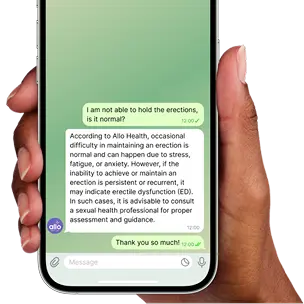
A doctor should be consulted if erectile dysfunction persists for more than a few weeks, affects mental health or relationships, or occurs alongside symptoms like chest pain, fatigue, or reduced sex drive. ED can be an early warning sign of cardiovascular disease or blood pressure problems.
There is no universal therapy for erectile dysfunction. What works best depends on age, underlying health conditions, and whether the concern is physical, psychological, or a combination of both.
Conclusion
Erectile dysfunction is a common and highly treatable condition with a wide range of effective treatments available. From lifestyle changes and psychological therapy to prescription drugs, mechanical devices, regenerative therapies, and surgical options, ED treatment should be personalized and evidence-based. Addressing blood flow, blood vessels, hormones, mental health, and overall Men’s Health leads to the best outcomes.
"The following blog article provides general information and insights on various topics. However, it is important to note that the information presented is not intended as professional advice in any specific field or area. The content of this blog is for general educational and informational purposes only.
Book consultation
The content should not be interpreted as endorsement, recommendation, or guarantee of any product, service, or information mentioned. Readers are solely responsible for the decisions and actions they take based on the information provided in this blog. It is essential to exercise individual judgment, critical thinking, and personal responsibility when applying or implementing any information or suggestions discussed in the blog."
Read more
Most Asked Questions
CCan ED Be Completely Cured With Therapy?
Erectile dysfunction can often be improved and, in some cases, fully resolved with the right therapy, especially when the underlying cause is identified early. For people whose ED is linked to stress, anxiety, lifestyle factors, or mild blood flow issues, therapy and lifestyle changes may lead to long-term improvement. However, when ED is caused by chronic conditions such as diabetes, heart disease, or nerve damage, treatment usually focuses on management rather than a permanent cure.
How long does ED therapy take to work?
The timeline depends on the type of therapy. Oral medications may work within hours, while sex therapy, lifestyle changes, or pelvic floor exercises can take several weeks to show noticeable improvement. Regenerative therapies and psychological treatments often require multiple sessions and consistent follow-up before results appear.
Is PRP therapy worth it for erectile dysfunction?
PRP therapy shows potential for improving erectile function by supporting tissue healing, but current evidence is limited. While some individuals report improvement, PRP is still considered an experimental treatment. It may be an option for selected patients after discussing risks, costs, and realistic expectations with a healthcare professional.
Are ED therapies permanent or temporary?
Some ED therapies provide temporary support, such as oral medications or mechanical devices that work only when used. Other approaches, including lifestyle changes, sex therapy, pelvic floor training, and certain regenerative treatments, may lead to longer-lasting improvement by addressing the root cause. Results vary from person to person.
Can ED be treated without medication?
Yes, erectile dysfunction can sometimes be treated without medication, especially in mild or stress-related cases. Sex therapy, counseling, physical activity, pelvic floor exercises, weight management, and stress reduction techniques can significantly improve erections without the need for prescription drugs.
This article was written by Dr. Pranitha Bangera, who has more than 2 years of experience in the healthcare industry.
Allo has the expertise of over 50+ doctors who have treated
more than 1.5 lakh patients both online and offline across
30+ clinics.
Our mission is to provide reliable, accurate, and practical health information to help you make informed decisions.
For This Article
We reviewed 50+ top-ranking medical and health articles on erectile dysfunction therapies to ensure this guide reflects the most current, evidence-based treatment approaches.
Our content is informed by urology guidelines and trusted medical sources such as Mayo Clinic, Harvard Health Publishing, and university-backed health systems.
We analyzed findings from multiple clinical studies and systematic reviews covering ED treatments, including medications, devices, psychological therapy, and emerging therapies.
We carefully distinguish between proven treatments and experimental options, clearly explaining benefits, limitations, and safety considerations.
We explored real-world concerns and questions raised on forums, patient discussions, and health communities to address what people genuinely worry about.
The article follows a patient-first, non-judgmental approach, focusing on education, safety, and informed decision-making rather than quick fixes or exaggerated claims.