Medical Conditions That Increase Erectile Dysfunction Risk
Written by Dr. Deepali Anand

Dr. Deepali is a medical writer and healthcare professional with a background in clinical surgery and patient care. Having transitioned from active clinical practice to medical communications, she specializes in bridging the gap between complex clinical data and patient education. Dr. Deepali is dedicated to creating evidence-based content that is grounded in scientific rigor and empathy, ensuring that sensitive topics like sexual wellness and mental health are accessible and empowering for every reader.
•
April 13, 2026
Our experts continually monitor the health and wellness space, and we update our articles when new information becomes available.
Quick Read
Erectile dysfunction is often not just a sexual issue, but a sign of underlying health conditions like diabetes, high blood pressure, heart disease, hormonal imbalances, or sleep problems. These conditions can affect blood flow, nerve signals, or hormones, all of which are essential for erections. In many cases, ED can act as an early warning sign of broader health concerns, especially related to the heart and metabolism.
If ED has started happening more often, it is easy to think of it as only a sexual problem. But many times, it is linked to a bigger health picture. Conditions like diabetes, high blood pressure, heart disease, obesity, hormone problems, and sleep issues can all raise the risk of erection problems. ED is often the body’s way of asking for a closer look at overall health.
What Is the Link Between Medical Conditions and ED?
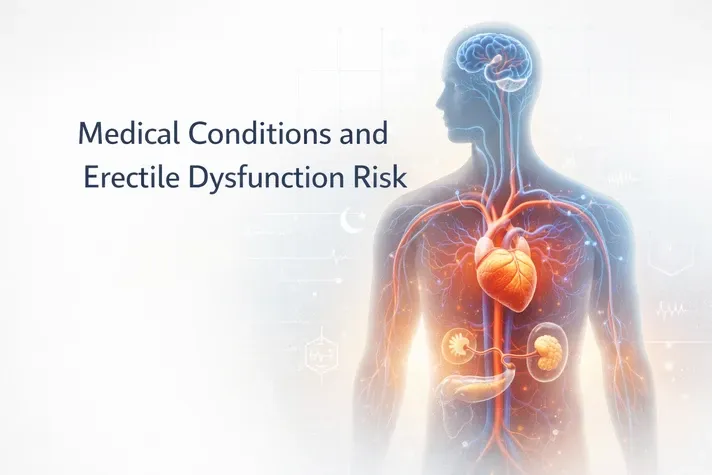
An erection depends on healthy blood vessels, working nerves, balanced hormones, and proper sexual arousal. Many medical conditions affect one or more of these systems. The NIDDK notes that diseases affecting blood vessels, nerves, or hormones can lead to ED.[1]
In simple terms, erectile dysfunction is often not random. It can be connected to how the heart, blood sugar, metabolism, sleep, and hormones are functioning.
इरेक्शन के लिए स्वस्थ ब्लड वेसल्स, सही नसों के सिग्नल, संतुलित हार्मोन, और उत्तेजना की सामान्य प्रक्रिया ज़रूरी होती है। कई मेडिकल समस्याएँ इनमें से एक या कई हिस्सों को प्रभावित कर देती हैं।
How Do Medical Conditions Affect Erections?
The most common pathway is blood flow. Conditions like diabetes, high blood pressure, high cholesterol, and heart disease can damage blood vessels, making it harder for enough blood to reach and stay in the penis.

Nerve damage can also matter, especially in diabetes. Hormonal issues, including low testosterone or thyroid problems, may reduce desire and erectile response.
These risks can build on each other and make erections less reliable over time. NIDDK notes that overweight and obesity raise the risk of diabetes and heart disease, and untreated sleep apnea raises the risk of diabetes and heart disease too. [2]
कई बार सबसे बड़ा असर ब्लड फ्लो पर पड़ता है। डायबिटीज, हाई BP, हाई कोलेस्ट्रॉल, और दिल की बीमारी लिंग तक खून पहुँचने की प्रक्रिया को प्रभावित कर सकती हैं। मधुमेह नसों को भी नुकसान पहुंचा सकता है। कुछ लोगों में हार्मोनल समस्या, जैसे कम टेस्टोस्टेरोन या थायरॉइड की दिक्कत, भी ED का कारण बनती है। अक्सर एक से ज़्यादा जोखिम कारक साथ मौजूद होते हैं।
What Should You Do Next?
If you think a medical condition may be raising your ED risk, the next step is evaluation, not guessing. Doctors often check blood sugar, cholesterol, blood pressure, and hormone levels depending on symptoms. Looking at the bigger picture matters because ED can be an early clue to underlying health problems, especially cardiovascular or metabolic ones.

अगर आपको लगता है कि किसी मेडिकल समस्या की वजह से ED का खतरा बढ़ रहा है, तो सबसे सही कदम जांच कराना है। डॉक्टर आपकी शुगर, BP, कोलेस्ट्रॉल, हार्मोन, और दूसरी सेहत की बातों को साथ में देख सकते हैं। कई बार सही बीमारी को कंट्रोल करने से इरेक्शन में भी सुधार आता है।
Explore More: Medical Conditions and ED Risk
English
- Priapism
- Can Fasting Cause Erectile Dysfunction
- Can a Calorie Deficit Cause Erectile Dysfunction
- Fast Heart Rate and Erectile Dysfunction
- Erectile Dysfunction After Colonoscopy
- Trichomoniasis and Erectile Dysfunction
- Can a Leaky Heart Valve Cause Erectile Dysfunction
- Impotence and Diabetes
- High Blood Pressure Erectile Dysfunction
- 20 With Erectile Dysfunction
- Obesity and Erectile Dysfunction
- Cholesterol and Erectile Dysfunction
- Varicoceles and Erectile Dysfunction
- COVID and Erectile Dysfunction
- Kidney Stones and Erectile Dysfunction
- Hernia and Erectile Dysfunction
- Hemorrhoids Piles and Erectile Dysfunction
- Prostate Cancer and Erectile Dysfunction
- Infertility and Erectile Dysfunction
- Thyroid Disorders and Erectile Dysfunction
- Heart Disease and Erectile Dysfunction
- Does an Enlarged Prostate Affect a Man Sexually
- Hydrocele and Erectile Dysfunction
- Erectile Dysfunction and Premature Ejaculation
- Can Bowel Problems Cause Erectile Dysfunction
- STD Causes Erectile Dysfunction
- Does UTI Cause Erectile Dysfunction
- Can Sciatica Cause Erectile Dysfunction
- Phimosis and Erectile Dysfunction
- Vasectomy and Erectile Dysfunction
- Can Being Sick Cause Erectile Dysfunction
- Herniated Disc Erectile Dysfunction Treatment
- Prostatitis Erectile Dysfunction
- Herpes and Erectile Dysfunction
- Older Men and Erectile Dysfunction
- Is Erectile Dysfunction Genetic
- Multiple Sclerosis and Erectile Dysfunction
- Can IBS Cause Erectile Dysfunction
- Can Hepatitis Cause Erectile Dysfunction
- Can Cold Weather Cause Erectile Dysfunction
हिंदी लेख

Disclaimer
The following blog article provides general information and insights on various topics. However, it is important to note that the information presented is not intended as professional advice in any specific field or area. The content of this blog is for general educational and informational purposes only. The content should not be interpreted as endorsement, recommendation, or guarantee of any product, service, or information mentioned. Readers are solely responsible for the decisions and actions they take based on the information provided in this blog. It is essential to exercise individual judgment, critical thinking, and personal responsibility when applying or implementing any information or suggestions discussed in the blog.
Most Asked Questions
Can diabetes increase the risk of ED?
Yes. Diabetes can damage both blood vessels and nerves, which makes it one of the strongest medical risk factors for ED.
Can heart problems show up as ED first?
Sometimes, yes. Because erections depend heavily on blood flow, ED can appear before other signs of vascular disease become obvious.
क्या दिल की बीमारी का शुरुआती संकेत ED हो सकता है?
कभी-कभी हाँ। क्योंकि इरेक्शन का सीधा संबंध ब्लड फ्लो से है, इसलिए ED पहले दिखाई दे सकता है।
अगर मुझे लगता है कि यह सिर्फ यौन समस्या है, तो क्या फिर भी जांच ज़रूरी है?
हाँ। बार-बार होने वाला ED कई दूसरी बीमारियों से जुड़ा हो सकता है, इसलिए सही जांच ज़रूरी है।
Why Should You Trust Us?
Why Should You Trust Us?
This article was written by Dr. Deepali Anand, who has more than 1 years of experience in the healthcare industry.
Allo has the expertise of over 50+ doctors who have treated more than 1.5 lakh patients both online and offline across 30+ clinics.
Our mission is to provide reliable, accurate, and practical health information to help you make informed decisions.
For This Article
- We reviewed 30+ top-ranking articles on medical conditions and erectile dysfunction to ensure this content is comprehensive, current, and aligned with real user queries.
- We referred to trusted medical sources, including guidance from organizations like NIDDK and clinical urology resources, to build a reliable and evidence-based foundation.
- We analyzed 20+ research papers and clinical studies exploring the link between cardiovascular health, diabetes, hormones, sleep disorders, and erectile dysfunction.
- We explored platforms like YouTube, Instagram, and Google search trends to understand what people commonly search and struggle with regarding ED and underlying health conditions.
- We reviewed discussions on Reddit and public health forums to capture real-world concerns, including confusion about whether ED is a symptom of larger health issues.